How does the discrete logarithm mod $p$ differ from the $e$-th root mod $N$, and why is it considered harder?
Both are "easy forward, hard backward," but the discrete logarithm has NO known trapdoor — nobody can compute it efficiently, regardless of what they know. This makes it fundamentally different from RSA's $e$-th root.
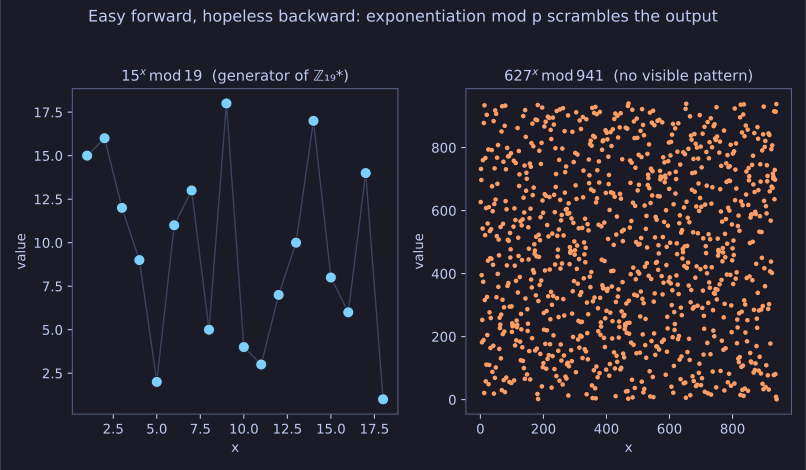
* Exponentiation mod $p$ scrambles the output: $15^x \bmod 19$ already jumps around, and $627^x \bmod 941$ looks purely random — so inverting it (the discrete log) has no shortcut. *
Concrete example: $15^x \mod 19$ (15 is a generator of $\mathbb{Z}_{19}^*$, so its powers cycle through all of $1..18$)
| $x$ | 1 | 2 | 3 | 4 | 5 | 6 | 7 | 8 | 9 | 10 |
|---|---|---|---|---|---|---|---|---|---|---|
| $15^x \mod 19$ | 15 | 16 | 12 | 9 | 2 | 11 | 13 | 5 | 18 | 4 |
The output jumps around with no pattern. Going forward ($x \mapsto 15^x$) is easy with SAM, but going backward is a search: to find $\log_{15} 4 \mod 19$ you must hunt for the $x$ with $15^x \equiv 4$ — here $x = 10$. With a 3000-bit prime in place of 19, that search is hopeless.
Comparison:
| $e$-th Root mod $N$ (RSA) | Discrete Log mod $p$ (DH/ECC) | |
|---|---|---|
| Forward | $y = x^e \mod N$ (easy) | $y = a^x \mod p$ (easy) |
| Backward | $x = \sqrt[e]{y} \mod N$ (hard) | $x = \log_a y \mod p$ (hard) |
| Trapdoor | Yes — knowing $p, q$ makes it easy | No — hard for everyone |
| Used in | RSA encryption/signatures | Diffie-Hellman, ElGamal, ECC |
Why "no trapdoor" matters: In RSA, the key holder CAN decrypt (using the trapdoor). In DH, nobody computes discrete logs — instead, the protocol is cleverly designed so both parties reach a shared secret without either one solving the hard problem.
Go deeper:
 Discrete logarithm (Wikipedia) — the no-trapdoor hard problem behind DH and ECC.