How does the paper-slip voting protocol (Zettelchen-Voting) implement MPC for a yes/no vote?
Each voter passes a slip in turn, adding +1 (yes) or +0 (no). The first voter starts with a large random number to hide their vote. The last value, minus the random starting number, is the total yes-count — but no voter ever sees how any other individual voted.
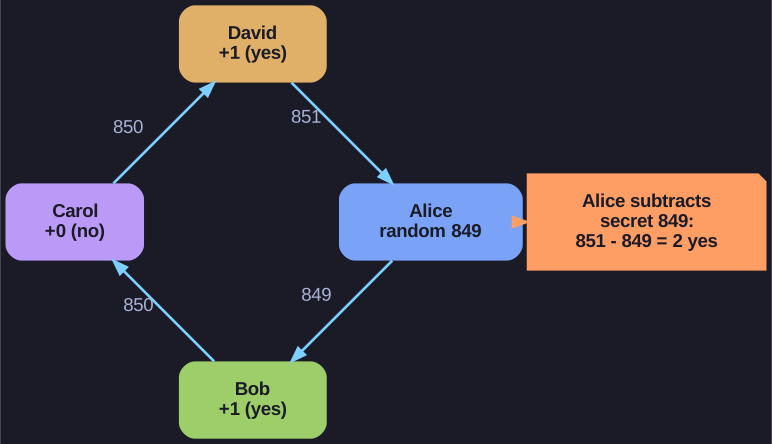
* Alice's random 849 is a one-time pad over the tally, so no individual vote is ever exposed. *
The protocol step by step (slide-by-slide):
- Alice (the first voter) writes a random large number on the slip — say
849. She passes it secretly to Bob. - Bob adds his own vote: if Yes,
+1→850; if No,+0→849. Passes secretly to Carol. - Carol does the same:
+1if Yes,+0if No. Passes to David. - David does the same. Passes back to Alice.
- Alice receives the final total (e.g.
851). She subtracts her secret random849→2. That's the number of Yes-votes. - Alice publicly announces the result: "2 yes-votes out of 4."
What each voter learns:
- ✓ The total count of yes-votes.
- ✗ How anyone else voted individually — they only see the slip's value when it's their turn, which combines the random base + earlier votes (unknown to them).
What makes this work:
- The random offset Alice chooses hides her own vote and everyone else's individual contributions.
- Each intermediate value reveals only the partial sum plus an unknown random — no individual decoder.
- The subtraction at the end is only possible by Alice, who knows the offset.
Trust assumptions (inherent to this kind of additive-sum protocol):
- Each voter honestly adds 0 or 1 — no one substitutes other values.
- No collusion — if Bob and David collude, they can compare their observed slips and isolate Carol's vote.
Why this is illuminating:
- It demonstrates MPC without computers — the protocol is fundamentally about information flow, not cryptography.
- A real e-voting system uses the same conceptual structure (homomorphic encryption replaces the random offset), but the security guarantees are provided by cryptographic hardness rather than physical envelopes.
Tip: The paper-slip protocol is exactly what's described as "secret-sharing-based MPC" in academic literature — Alice's r is a one-time pad over the sum. Real systems use Shamir secret sharing or additive secret sharing in finite fields, but the intuition is the same.
Go deeper:
 Secure multi-party computation (Wikipedia) — MPC via additive and Shamir secret sharing.