How does the ping command actually work at the protocol level, and how many echoes do Windows and IOS send?
Ping uses ICMP echo (Type 8) and echo reply (Type 0) messages to test Layer 3 connectivity; Windows 10 sends 4 echoes and expects 4 replies, while Cisco IOS sends 5 and shows an indicator per reply.
Ping works by sending an Internet Control Message Protocol (ICMP) echo request (Type 8) to a target IP address and waiting for an echo reply (Type 0) to come back. Each successful round trip proves that packets can travel out to the destination and back, which confirms working Layer 3 (network-layer) connectivity along the path. The reason the platforms differ is just a default: a Windows 10 host fires off four echo requests and tallies the four replies, while Cisco IOS sends five and prints one status character per reply (! for success, . for timeout), so you read the result as a row of indicators rather than a count. Because ping exercises only ICMP, a clean result tells you the path is up but says nothing about whether the application on that host is actually listening.
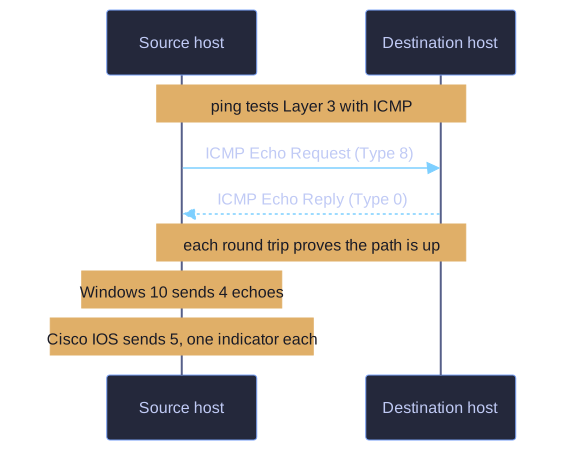
* ICMP Echo Request (Type 8) out, Echo Reply (Type 0) back — each round trip proves Layer 3 connectivity. *
Ping at the Protocol Level:
- The
pingcommand uses the Internet Control Message Protocol (ICMP): an echo request (ICMP Type 8) is sent and an echo reply (ICMP Type 0) is expected back. - A successful exchange confirms Layer 3 (network-layer) connectivity between source and destination IP addresses.
Number of messages:
| Platform | Echoes sent |
|---|---|
| Windows 10 host | 4 ICMP echo messages, expects 4 replies |
| Cisco IOS | 5 ICMP echo messages, one indicator displayed per reply |
Key insight: Because ping only tests ICMP, a successful ping confirms the path is up but does not prove that the actual application (e.g. a web or DNS service) is reachable on it.
Go deeper:
 What is ICMP? How Ping and Traceroute Help Troubleshoot Networks — animated walk-through of the echo request/reply exchange.
 Network Direction — ICMP for IPv4 — how ping's echo packets work, with the message-type table and the traceroute mechanism.
- Wikipedia — ICMP — the Type 8 / Type 0 messages and the rest of the control-message set.