Quiz Entry - updated: 2026.07.30
How does the UMTS architecture compare to GSM? What are the equivalent components?
UMTS reuses the GSM core network concepts but renames and enhances the radio access components — Node B replaces BTS, RNC replaces BSC, and the core adds parallel circuit and packet domains.
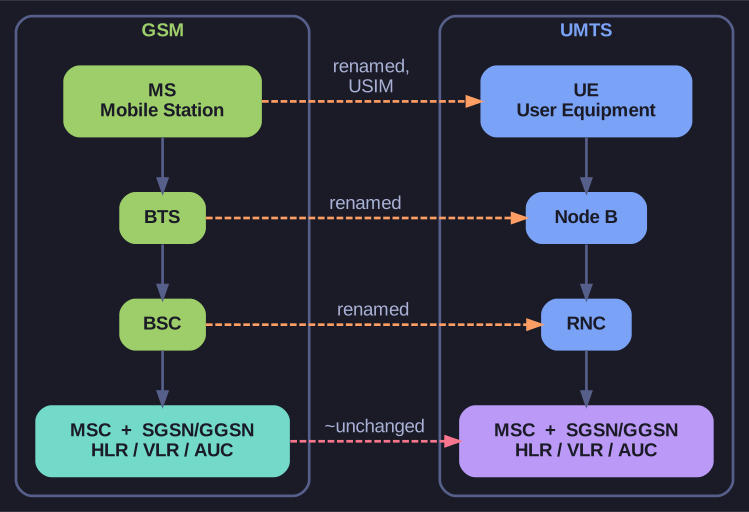
* The radio side was renamed and made more capable (MS→UE, BTS→Node B, BSC→RNC); the core network carried over from GSM/GPRS almost unchanged. *
Component mapping:
| GSM | UMTS | Change |
|---|---|---|
| MS (Mobile Station) | UE (User Equipment) | Renamed, USIM replaces SIM |
| BTS (Base Transceiver Station) | Node B | Renamed, more capable |
| BSC (Base Station Controller) | RNC (Radio Network Controller) | Renamed, more intelligent |
| BSS (Base Station Subsystem) | UTRAN | New name for entire radio access |
| Abis interface | Iub interface | Between base station and controller |
| A interface | Iu interface | Between radio access and core |
| — | Iur interface | New: between RNCs (enables inter-RNC soft handover) |
| MSC | MSC (unchanged) | Same role for circuit-switched voice |
| SGSN/GGSN | SGSN/GGSN (unchanged) | Same role for packet data |
| HLR/VLR/AUC | HLR/VLR/AUC (unchanged) | Same role for subscriber management |
Key insight: The UMTS core network is essentially the same as GSM+GPRS — the revolution happened in the radio access (CDMA instead of TDMA, soft handover, fast power control). This was deliberate — operators could upgrade the radio side without replacing the entire core infrastructure.
Go deeper:
 3G UMTS CDMA Technology: WCDMA (Electronics Notes) — the radio-access change this card calls the "revolution": why UMTS swapped GSM's TDMA for WCDMA, how spreading/scrambling codes work, and where soft handover comes from.