Quiz Entry - updated: 2026.10.26
How does Triple-DES (3DES) work and what is the EDE scheme?
3DES applies DES three times in an Encrypt-Decrypt-Encrypt (EDE) sequence with two or three different keys, providing approximately 112-bit effective security.
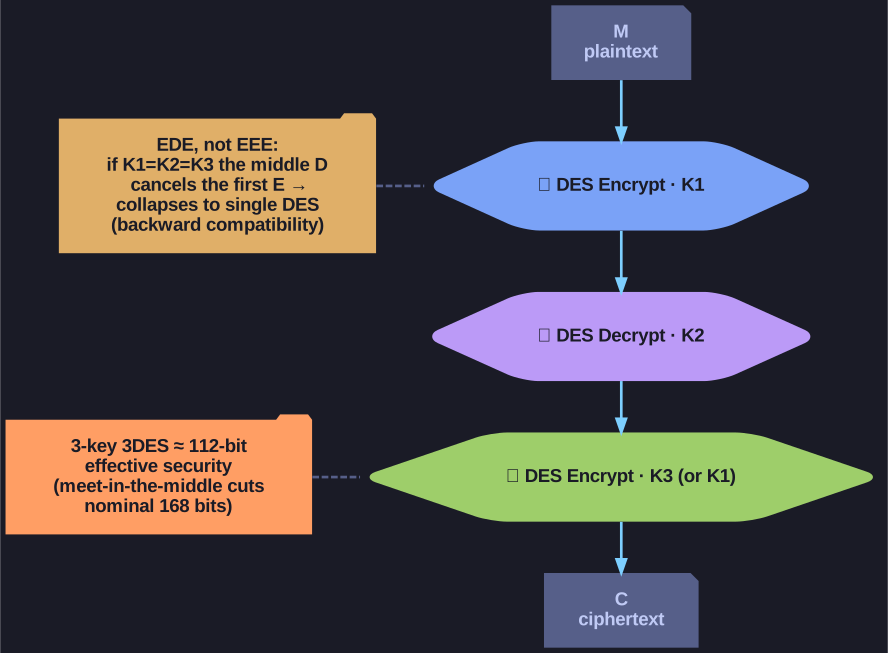
* 3DES runs DES as Encrypt-Decrypt-Encrypt, so equal keys collapse to single DES for compatibility. *
EDE with two keys ($K_1, K_2$):
$$\begin{aligned} \text{Encryption: } C &= E(K_1, D(K_2, E(K_1, M))) \\ \text{Decryption: } M &= D(K_1, E(K_2, D(K_1, C))) \end{aligned}$$
EDE with three keys ($K_1, K_2, K_3$):
$$\begin{aligned} \text{Encryption: } C &= E(K_3, D(K_2, E(K_1, M))) \\ \text{Decryption: } M &= D(K_1, E(K_2, D(K_3, C))) \end{aligned}$$
Why EDE (not EEE)?
- Backwards compatibility: if $K_1 = K_2 = K_3$, 3DES-EDE reduces to single DES (the $D$ in the middle cancels one $E$)
- This allowed gradual migration from DES to 3DES
Security:
- 2-key 3DES: only ~57–60 bits effective security (not allowed since 2009)
- 3-key 3DES: ~112 bits effective security (meet-in-the-middle reduces it from 168 bits)
- Much slower than AES (3x DES operations)
- 3-key 3DES permitted by NIST until 2030
Go deeper:
 Triple DES (Wikipedia) — EDE, the meet-in-the-middle bound, and deprecation timeline.