Quiz Entry - updated: 2026.07.30
How is a for loop translated to assembly?
A for is rewritten as a while (init; while(test){ body; update }), which is then rewritten as a guarded do-while — so it collapses into the same body + conditional-jump-back pattern.
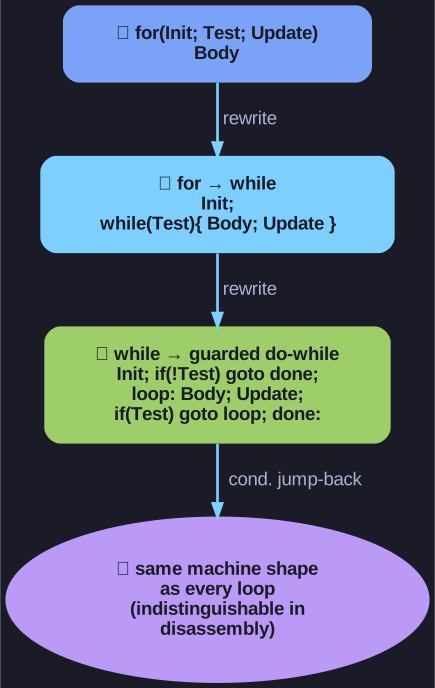
* for rewrites into a guarded do-while — every loop kind compiles to the same shape. *
The transformation chain a compiler walks:
for (Init; Test; Update) { Body }
   ↓  (for → while)
Init; while (Test) { Body; Update; }
   ↓  (while → guarded do-while)
Init;
if (!Test) goto done;
loop:
    Body
    Update
    if (Test) goto loop;
done:
Assembly (a typical for (i=0; i<n; i++)):
    movl $0, %eax       # Init: i = 0
.L_loop:
    # Body
    addl $1, %eax       # Update: i++
    cmpl %edi, %eax     # Test: i < n ?
    jl   .L_loop        # repeat while true
.L_done:
Why this matters for reverse engineering: Since all three loop kinds funnel into the same machine shape, you can't always tell from disassembly whether the original C was a for, while, or do-while — they look the same once compiled. You read the structure (init, body, update, back-edge), not the original keyword.
Go deeper:
 For loop (Wikipedia) — the three-part for loop.
 Compiler Explorer (godbolt) — watch for → while → do-while in real compiler output.