In a Challenge-Response (C-R) authentication protocol, why is simply sending a certificate insufficient to prove identity?
Because an attacker can intercept the certificate and replay it later — a certificate proves the existence of a key pair, not that the sender currently possesses the private key.
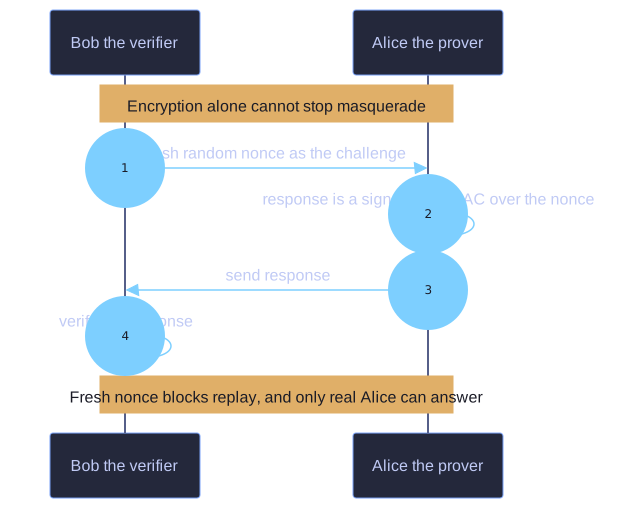
* Bob sends a fresh nonce; only the real Alice can sign it, and freshness blocks replay. *
Naive (broken) protocol:
- A → B: "I am A. Here is my certificate."
- B verifies the certificate is valid
Problem: Eve intercepts Alice's certificate. Next time, Eve sends the same certificate to Bob, pretending to be Alice. Bob accepts because the certificate is valid — but Eve sent it!
Proper C-R protocol:
- A → B: "I am A, prove you are B by signing this random nonce $N_A$"
- B → A: "Here is $\text{sig}(N_A)$ with my certificate" (B signs the nonce with B's private key)
- A verifies the signature on $N_A$ using B's public key from the certificate
Why this works:
- The nonce $N_A$ is fresh and unpredictable — Eve cannot prepare a valid signature in advance
- Only the real B possesses $K_{priv,B}$, so only B can sign the nonce
- The challenge (nonce) prevents replay — each authentication session uses a different random value
Key principle: In a C-R protocol, the verifier always asks a question (challenge) that only the authentic party can answer (response). Cryptographically, this means signing or MACing a random bitstring.
Go deeper:
 Challenge-response authentication — the protocol family behind identity proofs.