Quiz Entry - updated: 2026.07.30
In a dual-stack network, how does a DNS lookup decide between IPv6 and IPv4 — with a concrete example?
The resolver returns a AAAA record (IPv6) if one exists and an A record (IPv4) otherwise; e.g. hslu.ch had only an A record (147.88.201.68) so clients used IPv4, while dns.google has AAAA 2001:4860:4860::8888.
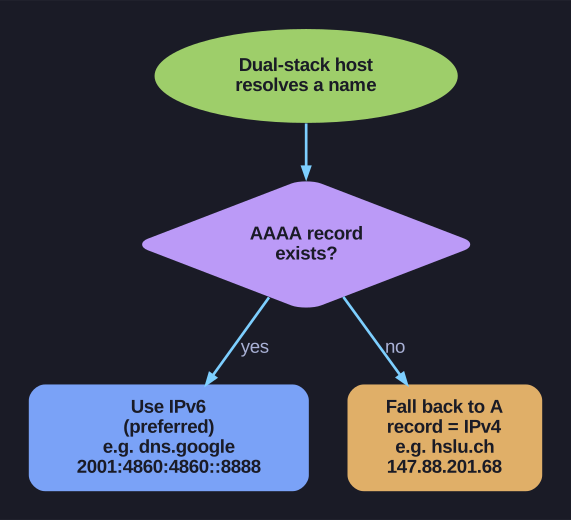
* DNS as the dual-stack switch: AAAA preferred, A as fallback. *
On a dual-stack host both protocols are available, and DNS is the switch:
- AAAA record → an IPv6 address (preferred when present)
- A record → an IPv4 address (the fallback)
Real example:
nslookup hslu.ch→ IPv4147.88.201.68, but the AAAA query returned "no address" → the host can only reach it over IPv4nslookup dns.google→ IPv62001:4860:4860::8888and::8844exist → the host can use IPv6
This is exactly why migration is gradual: a dual-stack client happily uses IPv6 for sites that publish AAAA and silently falls back to IPv4 for those that don't.
Tip: 2001:4860:4860::8888 / ::8844 are Google Public DNS over IPv6 — the direct counterparts of 8.8.8.8 / 8.8.4.4.
Go deeper:
 IPv6 transition mechanism (Wikipedia) — dual-stack operation and how AAAA-vs-A drives protocol selection.