In a normative (moral) Toulmin argument, what special constraint applies to the warrant?
The warrant (and the conclusion) must themselves be normative — you can't derive an "ought" conclusion from a purely factual warrant.
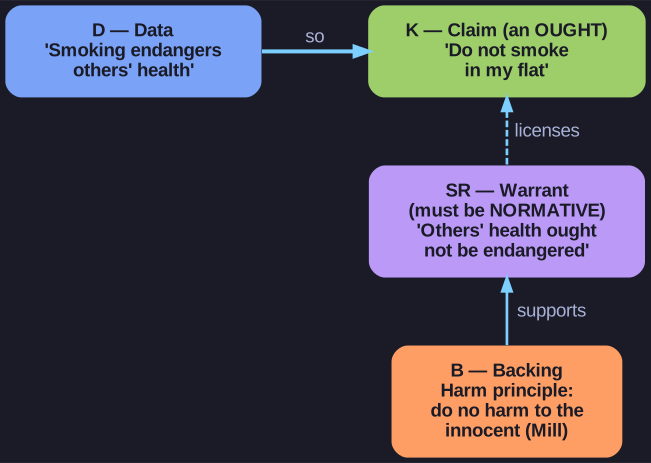
* A normative Toulmin argument — the warrant itself must be an 'ought', not a mere fact. *
For a normative argument — one whose conclusion is about what one should do — the rule is: the warrant (SR) must be normative, just like the conclusion. It has to express a general moral principle, not merely a fact. Example:
- Claim (K): "You shall not smoke in my flat" — a prohibition, telling you how to act.
- Data (D): "Smoking endangers the health of those present."
- Warrant (SR): "The health of others ought not to be endangered" — note this is itself an ought-statement.
- Backing (B): a moral principle, e.g. the harm principle: "You may not inflict harm on any innocent person" (J. S. Mill).
If the warrant were merely "smoking endangers health" (a fact), it couldn't license a should. The bridge from facts to an "ought" conclusion must itself contain an "ought."
Tip: This is the "no ought from is" point in disguise: a moral conclusion needs at least one moral premise. The warrant is where that moral premise lives.
Go deeper:
 Is–ought problem (Wikipedia) — Hume's point that no 'ought' follows from a purely factual 'is'.
- Stephen Toulmin — the model of argument (Wikipedia) — the warrant's role in the scheme.