In symmetric cryptography, how do Alice and Bob exchange a message — and what is the catch?
Both share a secret key sk. Alice encrypts with c = E(m, sk), Bob decrypts with m = D(c, sk). The catch: the shared key must somehow be agreed on or transmitted before any encrypted communication can start.
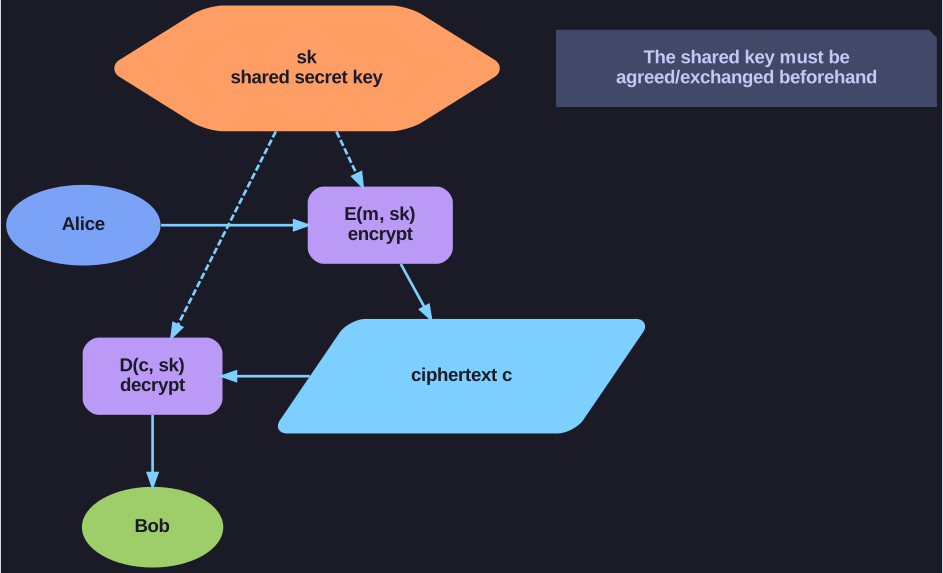
* One shared key sk both sides: Alice computes c = E(m, sk), Bob computes m = D(c, sk) — but sk must be agreed/exchanged beforehand. *
The mechanics are simple: same key, same algorithm, both sides. Symmetric = key is symmetric between sender and receiver.
The key-exchange chicken-and-egg problem:
- If you have no secure channel yet, how do you agree on the key?
- Hand-delivery, sealed envelopes by courier, pre-loaded smartcards — all real options but operationally painful.
- Diffie-Hellman key exchange (1976) solved this for the modern internet: two parties can derive a shared secret over a public channel without prior contact. (This is asymmetric cryptography's domain.)
Why we still want symmetric crypto even in the age of public-key:
- Speed: AES on modern CPUs (with AES-NI) is ~10 GB/s; RSA is ~1000× slower.
- Compactness: A 256-bit symmetric key has the same security as a ~15,000-bit RSA key.
- The standard pattern in TLS, SSH, Signal, etc.: use asymmetric crypto to bootstrap a symmetric session key, then encrypt the actual data with the symmetric key. Best of both.
Tip: Whenever you see "symmetric vs asymmetric", the right answer is usually "both" — modern protocols are hybrid by design.
Go deeper:
 Symmetric-key algorithm (Wikipedia) — the shared-key model and the key-distribution problem it creates.