In the classic "17 horses" inheritance story, what makes the neighbour's borrowed 18th horse such a good image of solution-focused thinking?
The 18th horse is a resource added from outside the problem's frame: with it the "impossible" division suddenly works, and it returns to its owner unused — the solution had a different quality than the problem.
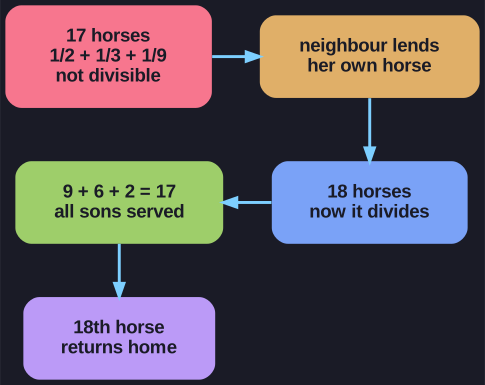
* The borrowed 18th horse changes the frame, the shares work out, and the resource walks home unused. *
The story: a father wills his 17 horses to three sons — half to the eldest, a third to the middle son, a ninth to the youngest. 17 can't be divided by 2, 3 or 9, so the sons argue themselves into a stalemate. A neighbour quietly adds her own horse to the herd: of 18 horses the eldest takes 9, the middle son 6, the youngest 2 — that's 17 — and the 18th horse, no longer needed, walks back to the neighbour.
Why solution-focused practice loves this story:
- Harder problem-analysis could never have produced the answer. Re-arguing the fractions of 17 only deepens the stalemate; the way out came from changing the frame, not from dissecting the impasse.
- The solution is "a context of a different quality," not the problem's opposite. Nobody negated the dispute — a new arrangement appeared in which the dispute simply had no place anymore.
- The borrowed horse is what a resource is. Temporarily added, fully returned: an outside element (a question, a perspective, a helper) can unlock a stuck system without having to become part of it.
The arithmetic even explains why the problem was unsolvable as posed: 1/2 + 1/3 + 1/9 = 17/18, not 1 — the father's shares never added up to the whole estate. The flaw lived in the problem's own frame, which is exactly where the solution didn't.
Tip: When a problem is impossible as posed, don't push harder on the fractions — ask what borrowed "18th horse" would change the frame.
Go deeper:
 Wikipedia — 17-animal inheritance puzzle — the puzzle's history and the arithmetic of why the shares never summed to one.