In the smart-fridge case, what are the pros and cons of alternative A1: connecting the fridge through the workplace LAN and the web proxy to the internet?
Pro: the smart features work, and the proxy can control what the fridge sends to the internet. Con: the app-to-server traffic cannot be controlled, nobody knows how the fridge gets patches and security updates, the fridge's own security is out of the dairy's hands, a hacked fridge puts an attacker into the workplace LAN and can spoil the food, and set-up and operation cost effort.
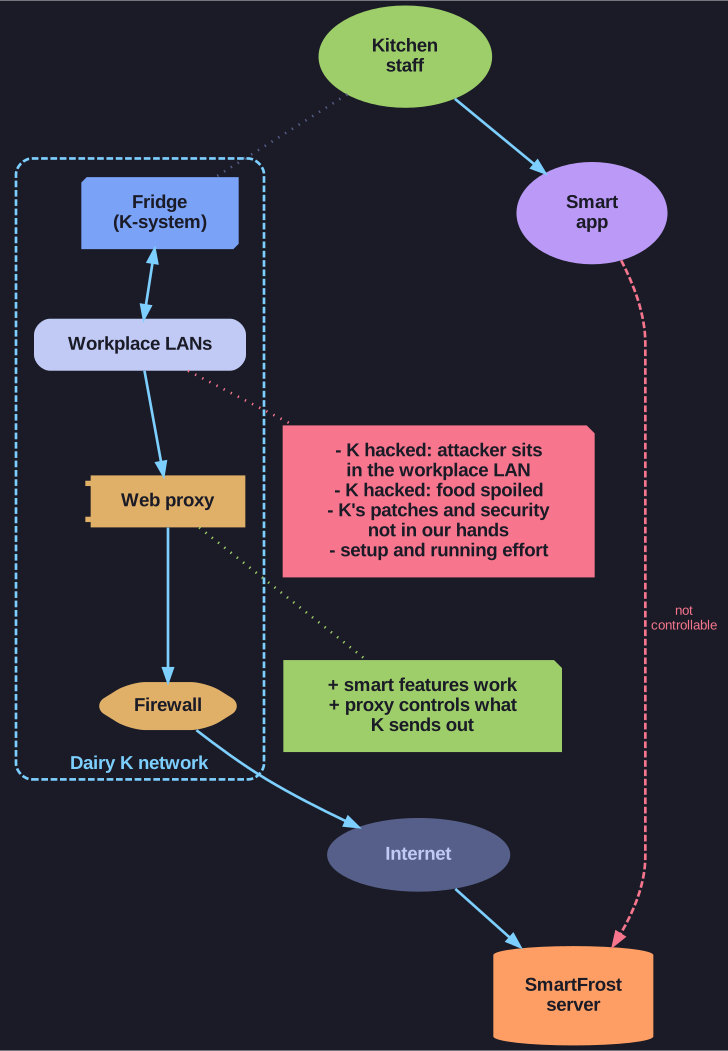
* The fridge joins the workplace LANs and reaches its vendor through the web proxy; the app reaches the vendor directly. *
The set-up: a new smart fridge (the F-2000i) in a cheese dairy's canteen wants internet access so the kitchen staff can read and change its state through the vendor's SmartFrost app and server. In A1 the fridge is plugged into the workplace LANs, and its traffic to the vendor's server goes out through the web proxy and the firewall.
Pros:
- the smart features work,
- the web proxy can control what goes from the fridge into the internet.
Cons:
- the traffic between the app and the SmartFrost server bypasses the dairy entirely, so it cannot be controlled,
- patches and updates, above all security updates, are an open question,
- the security of the fridge itself cannot be controlled: it is the vendor's device,
- if the fridge is hacked, the attacker sits in the workplace LAN, next to the employees' computers,
- a hacked fridge can also spoil the food (wrong temperature),
- effort for configuration, set-up and ongoing operation.
Go deeper:
 Mirai (malware) — Wikipedia — how hundreds of thousands of poorly secured connected devices were taken over.
- OWASP Internet of Things Project — the IoT Top 10, including insecure update mechanisms and insecure ecosystem interfaces.