In the smart-fridge case, what are the pros and cons of alternative A3: giving the fridge a network port in the DMZ?
Pro: full functionality, since the operating state can be read through the app. Cons: higher risk, because an attacker could move laterally from the fridge to the other systems in the DMZ and the fridge could be manipulated via the internet; and higher effort, because the fridge then needs security operations such as security scans, network monitoring and alarming.
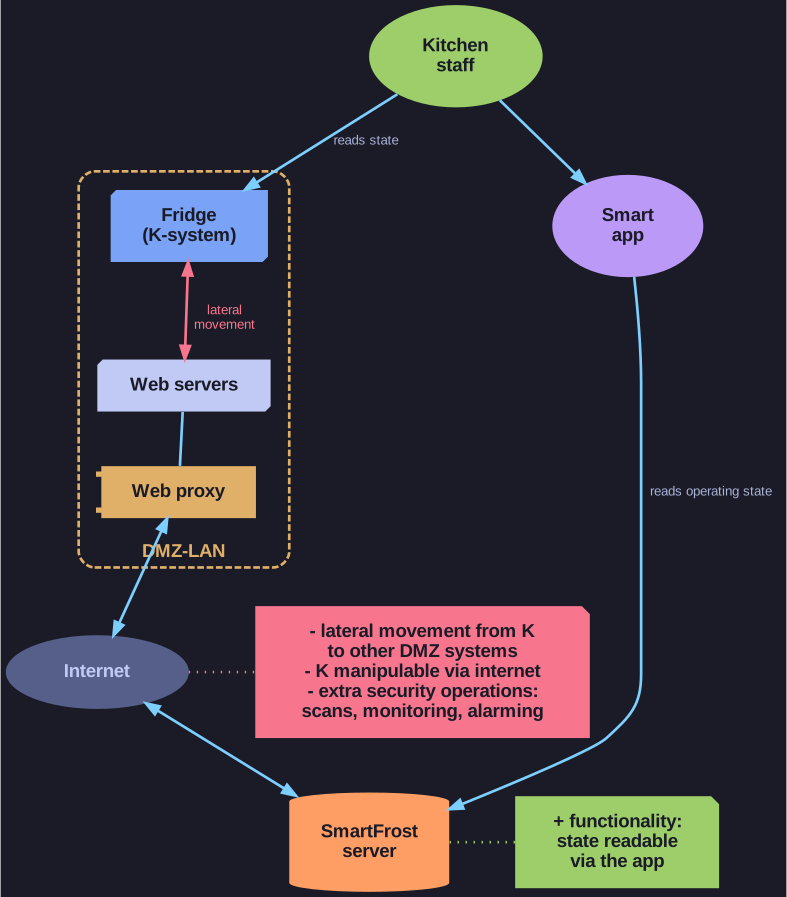
* In the DMZ the fridge sits next to the web servers, away from the workplace LANs but within reach of the internet. *
The set-up: a new smart fridge (the F-2000i) in a cheese dairy's canteen wants internet access so the kitchen staff can read its state through the vendor's SmartFrost app and server. The dairy already runs a DMZ-LAN, a separate network zone between the internet and the internal networks, holding its web servers and the web proxy. In A3 the fridge gets its network port there.
Compared with A1 (fridge in the workplace LAN), the DMZ keeps a hacked fridge away from the employees' computers. But it places the fridge among the systems that face the internet:
- Lateral movement: from the fridge, an attacker could reach the web servers and other DMZ systems.
- Manipulation via the internet: the fridge's state could be changed from outside.
- Security operations: like every DMZ system, the fridge would need scans, network monitoring and alarming, which is extra effort for a kitchen appliance.
Go deeper:
 DMZ (computing) — Wikipedia — the zone between the internet and the internal network, and why its hosts are exposed.
- MITRE ATT&CK TA0008 — Lateral Movement — the techniques an attacker uses to move from one foothold to the next system.