Into which four components can the business model of a local energy market be abstracted?
Market roles (who participates), market assets (what is produced, stored and measured), market ownership and objective (who owns it, what it optimises), and the trading mechanism (how energy is exchanged).
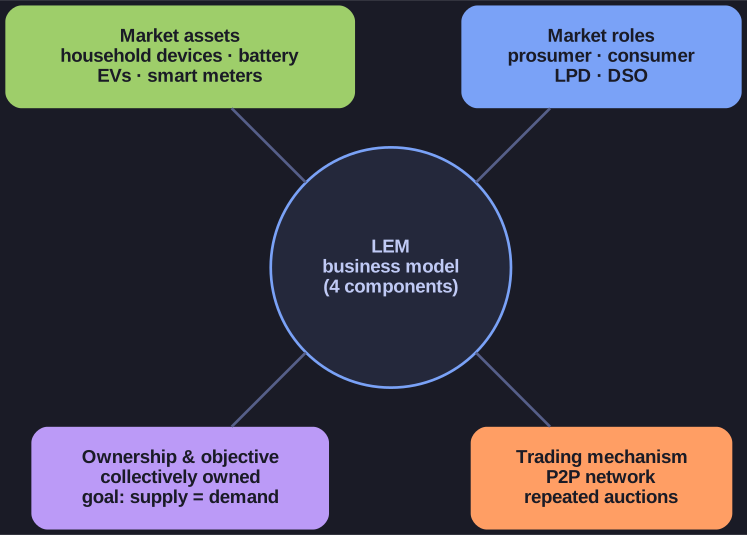
* The four axes along which any local energy market can be described: who trades, what is managed, who owns it and to what end, and how exchange works. *
Abstracting the market into four components makes the design portable — any city-district market can be described, compared, and automated along the same axes:
| Component | What it covers |
|---|---|
| Market roles | The entities and their duties: prosumers and consumers trade; the LPD regulates; the DSO runs the metering infrastructure |
| Market assets | The physical/digital resources: household assets (devices like a washing machine that don't trade themselves but shape consumption and thus decisions), batteries, electric vehicles, and smart meters |
| Ownership & objective | Collectively owned, with one primary objective: dynamic supply-demand balancing |
| Trading mechanism | A P2P network where any role can buy or sell, priced by repeated auctions |
The least obvious asset is the first: household devices never appear on the market, yet their usage patterns are exactly what the endpoint's forecasting AI must learn — they participate indirectly, through the data they generate.
Go deeper:
 Electricity market (Wikipedia) — how real-world markets organise the buying and selling the four-component model abstracts.