Quiz Entry - updated: 2026.07.30
Of checksum, hash, MAC, and digital signature — which security properties does each provide?
Each step adds a property: checksum→error detection, hash→+integrity, MAC→+authenticity, signature→+non-repudiation.
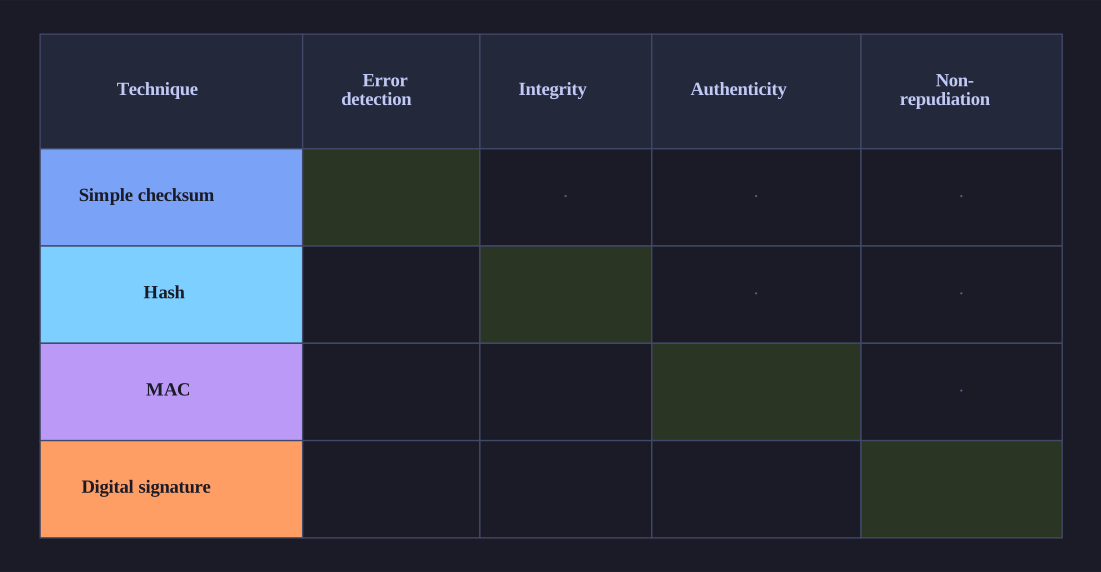
* A cumulative ladder — each technique keeps every property below it and adds exactly one more, from error detection up to non-repudiation. *
| Mechanism | Error detection | Integrity | Authenticity | Non-repudiation |
|---|---|---|---|---|
| Simple checksum | ✓ | |||
| Hash value | ✓ | ✓ | ||
| Message Authentication Code (MAC) | ✓ | ✓ | ✓ | |
| Digital signature | ✓ | ✓ | ✓ | ✓ |
The logic of the ladder:
- A hash detects any change (not just accidental) — but anyone can recompute it, so it doesn't prove who sent it.
- A MAC adds a shared secret key → now only someone with the key could have produced it (authenticity) — but both parties share the key, so neither can prove to a third party who created it.
- A digital signature uses the sender's private key → only they could sign, and anyone can verify with the public key → the sender can't later deny it (non-repudiation).
Tip: Non-repudiation needs asymmetric crypto (a key only the signer holds). A shared secret (MAC) can never give it, because either party could have made the tag.
Go deeper:
 Message authentication code (Wikipedia) — MAC = integrity + authenticity via a shared secret, and why a shared-key MAC gives no non-repudiation.
- Digital signature (Wikipedia) — public-key signatures add non-repudiation — the top rung a MAC cannot reach.