Static vs dynamic routing — when would you choose each?
Use static routing for small, stable, non-redundant networks and default routes; use dynamic routing when the network is larger or has redundant paths that must adapt automatically to topology changes.
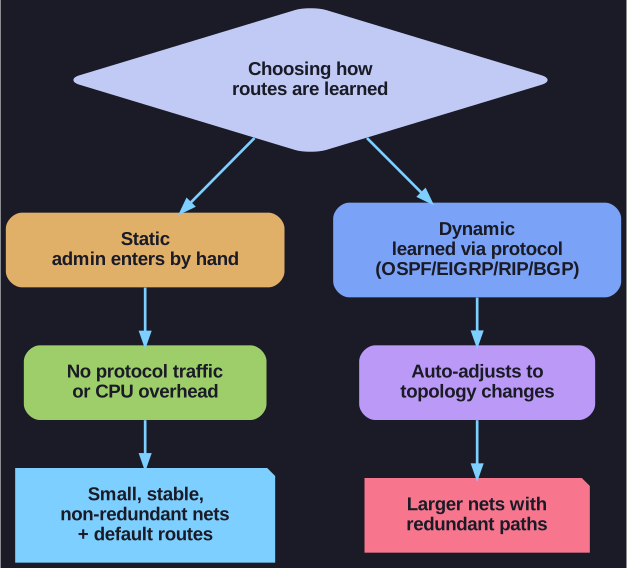
* Static routes are entered by hand with no protocol overhead, suiting small stable networks and default routes; dynamic routing learns paths via a protocol and auto-adjusts, suiting larger networks with redundant paths. *
| Static routing | Dynamic routing | |
|---|---|---|
| How routes appear | Entered manually by the admin | Learned automatically via a routing protocol |
| Response to a topology change | Must be re-configured by hand | Adjusts automatically, finding new best paths |
| Best suited for | Small, non-redundant networks; default routes | Larger networks with redundant paths |
| Overhead | No protocol traffic or CPU for route exchange | Consumes bandwidth/CPU to exchange updates |
They are not mutually exclusive: a common pattern is to run a dynamic protocol internally while configuring a static default route to the ISP — and dynamic routing can even propagate that static default to other routers.
Why it matters: A static route will not fail over if its path goes down, so on networks with backup links the lack of automatic adjustment is the deciding factor in favor of dynamic routing.
Go deeper:
-
 Static routing (Wikipedia) — its low overhead and security upside, and the no-automatic-failover limitation that rules it out on redundant networks.
 -
Dynamic routing (Wikipedia) — how protocols like OSPF, EIGRP and RIP adapt to topology changes automatically, the case for larger networks.