Quiz Entry - updated: 2026.07.30
Tell the whole evolution story: how did mobile architecture change from 2G to 5G, and WHY did each shift happen?
The arc is one long migration from circuit-switched, voice-only, multi-box networks toward a flat, all-IP, software-defined core — driven by the explosion of data traffic and the need for efficiency.
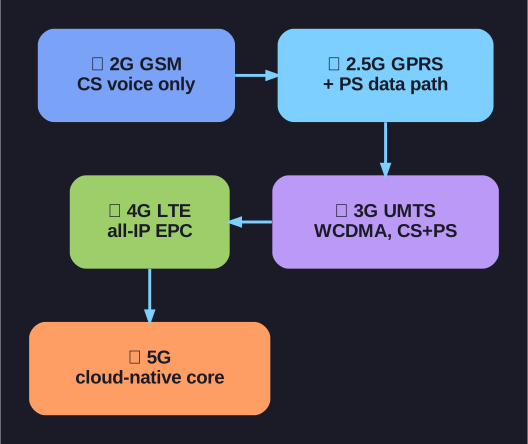
* 2G to 5G: from circuit-switched voice toward an all-IP, cloud-native core. *
A narration you could give out loud, generation by generation:
| Gen | Transport | Voice core | Data core | Radio (base station) | Big idea |
|---|---|---|---|---|---|
| 2G (GSM) | Circuit-switched only | BTS→BSC→MSC→GMSC | — | BTS / BSC | Digital voice + SMS; channels reserved per call |
| 2.5G (GPRS) | CS voice + PS data | unchanged MSC | SGSN→GGSN added in parallel | shared BTS/BSC | Bolt data onto GSM without touching the voice core |
| 3G (UMTS) | Parallel CS + PS | MSC/VLR→GMSC | SGSN→GGSN | Node B / RNC (UTRAN, WCDMA/HSPA) | New, faster radio; same two-domain core |
| 4G (LTE) | All-IP, packet only | eliminated — VoLTE | MME + S-GW/P-GW + HSS (EPC) | eNodeB (flat, no RNC) | Collapse voice+data into one IP core; split control/user plane |
| 5G | All-IP, cloud-native | over IMS/IP | NSA: reuse EPC · SA: new 5G Core | gNodeB (5G-NR) | Service-based, software-defined core; slicing, URLLC |
The "why" behind each step (the part that really matters):
- 2G→2.5G: the internet arrived. Operators needed packet data but couldn't afford to rip out their voice switches, so they ran a parallel packet network (SGSN/GGSN).
- 2.5G→3G: demand for faster data + better spectral efficiency drove a new radio (WCDMA). The core stayed two-domain because voice still needed guaranteed circuits.
- 3G→4G: data dwarfed voice. Reserving circuits for voice was wasteful, so everything went all-IP — even voice (VoLTE). The radio was flattened (RNC removed, its job pushed into the eNodeB) to cut latency, and control plane was separated from user plane so each can scale independently.
- 4G→5G: the core itself became cloud-native software (a service-based architecture, an SDN/NFV idea), enabling network slicing (virtual networks per use-case) and URLLC (ultra-reliable low latency). NSA reuses the 4G core for a fast start; SA delivers the full vision.
Two through-lines to remember: (1) transport steadily moved circuit→packet→all-IP; (2) the architecture steadily flattened and softwarized — fewer dedicated boxes, more general-purpose IP and cloud, control split from data.
Go deeper:
 Harald Welte — What happens on a protocol level when I switch on my phone? (CCC, 2018) — a live walk through the 2G/3G attach procedure that makes the early-generation network boxes concrete (the left half of this table).
- 5G Core — design principles, network elements & service-based architecture (WinInk) — picks up where the CCC talk stops, showing how the 4G→5G step turns the core into cloud-native software (the SBA / control-user-plane idea in the last table row).