To which antenna does a mobile device connect — what does theory predict, and what does practice actually show?
Theory predicts the device connects to the nearest antenna, then refined to the antenna with the strongest signal (signal power falls off as I = I₀/4πr²). In practice, this cannot be predicted categorically — the strongest antenna is usually but not always chosen — so the only reliable approach is to measure.
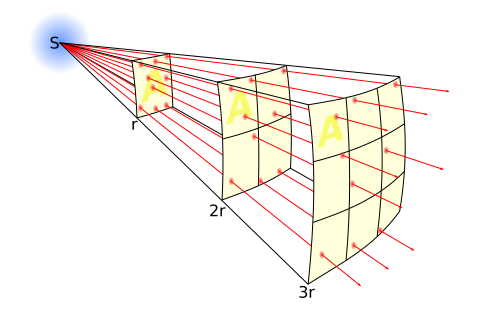
* Signal intensity falls as 1/r² with distance. — Borb, CC BY-SA 3.0, via Wikimedia Commons. *
Theory builds up in steps. The first guess is that a device connects to the nearest antenna. That gets refined to the antenna with the strongest signal, because the dominant selection factor inside the device is signal strength (the exact rule varies by technology), and signal intensity follows the inverse-square law of wave propagation, I = I₀ / (4πr²) — power falls off with the square of the distance. But the refinement immediately runs into trouble: not all antennas transmit equally strongly, the environment weakens signals, which antennas are even available varies from spot to spot, and which one is effectively strongest at a given point is far from obvious.
Empirical field research bears this out. The strongest antenna is indeed chosen most often — in one study about 90% and 82% of connections at two test sites went to the single strongest cell, so "most often" is high but plainly not "always." Devices also tend to prefer a particular frequency, and topology matters (a lake, for instance, lets a signal carry over long distances). The honest conclusion is that we currently cannot categorically predict which antenna a device will pick — so the best approach is to measure, not to compute or assume.
This is the heart of the topic, because the entire evidential value of cell-location evidence rests on this device-to-antenna link, and the scientifically honest answer is that the link is probabilistic and environment-dependent, not deterministic. Overconfident claims that "the phone must have been on this antenna" are exactly what disciplined forensic practice resists.
Tip: Theory says "strongest signal (inverse-square law)"; reality says "usually, but measure to be sure." The inverse-square formula I = I₀/4πr² is worth remembering as the physical basis.
Go deeper:
 Cellular network (Wikipedia) — how cells, coverage footprints, and cell selection work; the foundation for why a device-to-antenna link is probabilistic rather than fixed (kept: feeds the carousel).
- GSM network architecture — BTS, cells & registration (Electronics Notes) — the base-station/cell layer in detail, including how a phone registers and the network learns "which BTS it communicates with" — the exact device-to-antenna link this card probes.