Walk through a concrete linkage attack: a hospital removes names and publishes records with Age, Gender, ZIP, and Diagnosis, while the commune publishes a public voter list (Name, Age, Gender, ZIP). What can an attacker recover, and what is the residual leak for records that aren't unique?
By matching the shared quasi-identifiers (Age, Gender, ZIP), the attacker re-attaches names to most records and learns their diagnosis; even a tie of two candidates still leaks the sensitive value to a 1-of-2 guess.
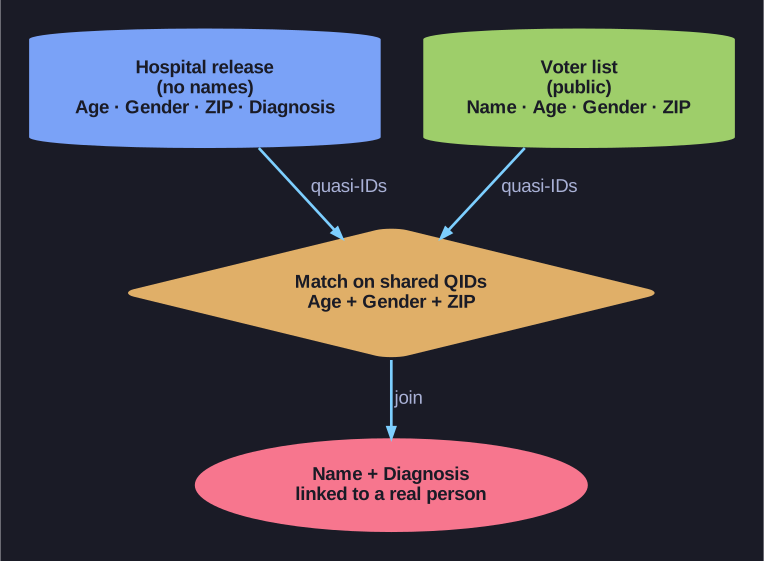
* Joining two tables on shared quasi-identifiers re-attaches a name to a diagnosis. *
The mechanics, step by step:
- Shared QIDs = Age, Gender, ZIP (they appear in both tables). Diagnosis exists only in the hospital release (the sensitive attribute); Name only in the voter list (the direct identifier).
- Linkage: join the two tables on {Age, Gender, ZIP}. Any hospital record whose QID combination is unique in the voter list gets exactly one name — and its diagnosis is now attached to a real person.
- Typical result: in an 8-record toy hospital release, 6 of 8 records (75%) link to a single name; only one QID combination (e.g. two 28-year-old women in the same ZIP) ties.
The subtle lesson is the residual leak on the tied records: even when two names match, the attacker learns that one of these two women has migraine and the other has anxiety — a 1-of-2 attribute disclosure, far worse than the 1-of-8 uncertainty before linkage. Non-unique does not mean safe.
Tip: "We removed the names" is pseudonymization, not anonymization. The fix is k-anonymity (generalise age into ranges, ZIP into 600*) plus l-diversity on the diagnosis — and verifying no equivalence class is smaller than k before publishing.