Walk through the complete packet forwarding process from PC1 to PC3 across three routers using static routes.
PC1 sends to its default gateway (R1) → R1 looks up destination in routing table, finds static route, forwards to R2 → R2 does the same, forwards to R3 → R3 has a directly connected route, ARPs (Address Resolution Protocol) for PC3's MAC (Media Access Control), and delivers the frame.
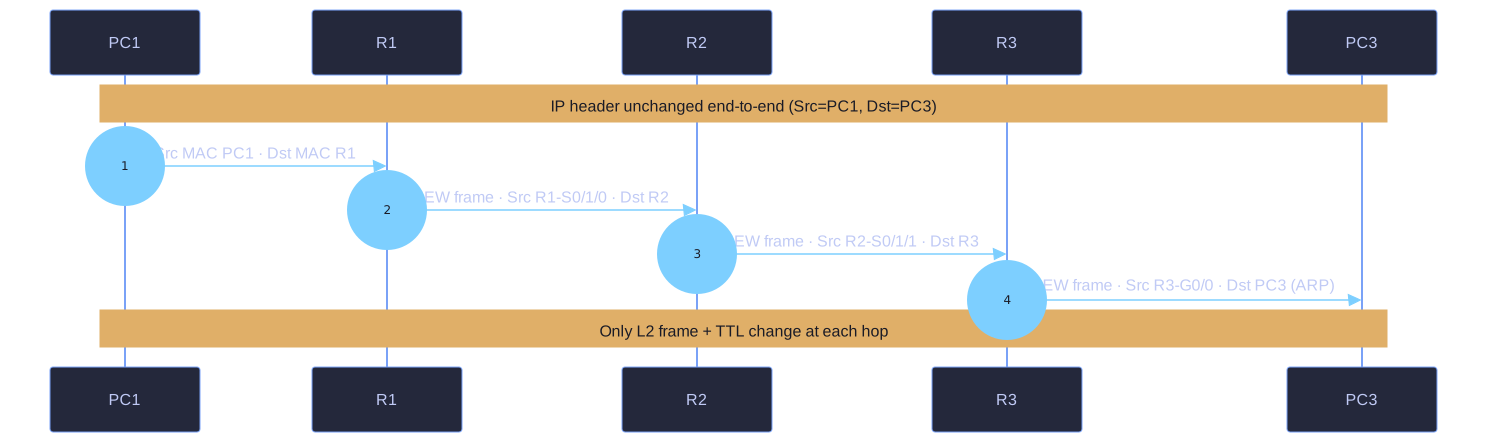
* Hop-by-hop L2 re-encapsulation, IP (Internet Protocol) preserved. *
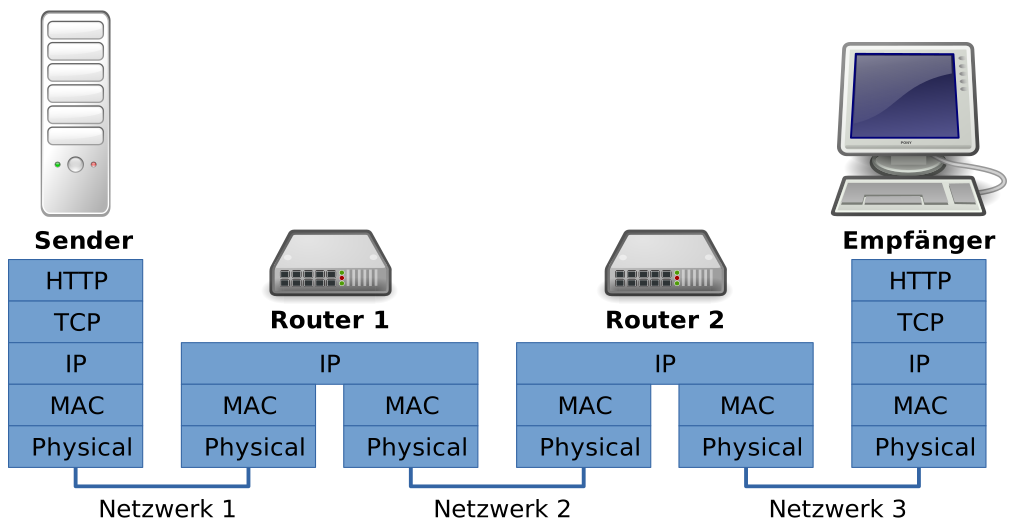
* End-to-end forwarding rebuilt hop-by-hop. — the Tango! project, CC BY-SA 3.0, via Wikimedia Commons. *
Step-by-step forwarding (PC1 → R1 → R2 → R3 → PC3):
Step 1 — PC1 to R1:
- PC1 creates packet with destination IP = PC3's IP
- PC1's default gateway is R1 → PC1 ARPs for R1's MAC
- PC1 sends the frame:
[Src MAC: PC1, Dst MAC: R1-G0/0]
Step 2 — R1 processing:
- R1 receives frame on G0/0/0, strips Layer 2 header
- R1 searches routing table for PC3's destination IP
- Static route matches → next-hop is R2 (via S0/1/0)
- R1 builds new frame:
[Src MAC: R1-S0/1/0, Dst MAC: R2-S0/1/0] - Forwards out Serial0/1/0
Step 3 — R2 processing:
- R2 receives on S0/1/0, strips L2, searches routing table
- Static route matches → next-hop is R3 (via S0/1/1)
- Builds new frame, forwards out S0/1/1
Step 4 — R3 to PC3:
- R3 receives, searches routing table
- Destination matches a directly connected network (G0/0/0)
- R3 checks ARP table for PC3's MAC address
- If no ARP entry → sends ARP Request on G0/0/0
- PC3 responds with ARP Reply
- R3 encapsulates:
[Src MAC: R3-G0/0, Dst MAC: PC3] - PC3 receives and processes the packet
Key observation: The IP header (source = PC1, destination = PC3) stayed the same at every hop. Only the Layer 2 frame was rebuilt at each router.
Go deeper:
 Network layer (Wikipedia) — why the L3 IP header is preserved end-to-end while each hop is a separate forwarding step.