Quiz Entry - updated: 2026.10.26
Walk through the complete RSA key generation, encryption, and decryption process.
Generate two primes $p, q$; compute $N = pq$ and $\varphi(N) = (p-1)(q-1)$; choose $e$ coprime to $\varphi(N)$; compute $d = e^{-1} \mod \varphi(N)$. Encrypt: $c = m^e \mod N$. Decrypt: $m = c^d \mod N$.
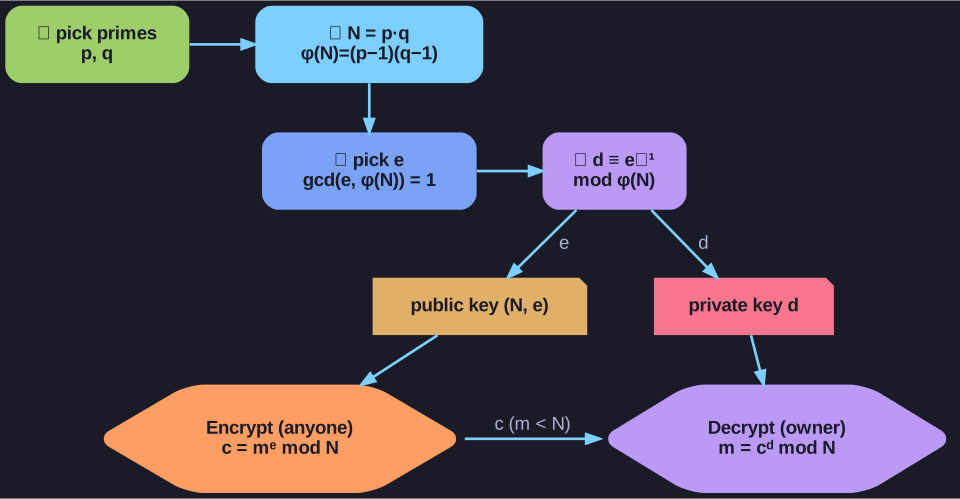
* Key generation splits into a public key anyone uses to encrypt and a private key only the owner uses to decrypt. *
Key Generation:
- Choose two large primes $p$ and $q$ (each ~1536 bits for 3072-bit RSA)
- Compute $N = p \cdot q$ (the modulus)
- Compute $\varphi(N) = (p-1)(q-1)$
- Choose public exponent $e$ with $\gcd(e, \varphi(N)) = 1$
- Compute private exponent $d \equiv e^{-1} \mod \varphi(N)$
Keys:
- Public key: $(e, N)$ — published
- Private key: $d$ (plus $p, q$ for optimization)
Encryption (Bob sends to Alice): $c \equiv m^e \mod N$ Decryption (Alice): $m \equiv c^d \mod N$
Why it works (proof via Euler): $c^d \equiv (m^e)^d \equiv m^{e \cdot d} \equiv m^{r \cdot \varphi(N) + 1} \equiv (m^{\varphi(N)})^r \cdot m \equiv 1^r \cdot m \equiv m \mod N$
Constraint: Message $m$ must satisfy $m < N$.
Go deeper:
 The RSA Encryption Algorithm — computing an example (Eddie Woo) — a full keygen-encrypt-decrypt worked by hand.
 RSA cryptosystem — key generation & operation (Wikipedia) — the same steps with the Euler-theorem correctness proof.