Quiz Entry - updated: 2026.07.30
Walk through the four steps that turn a raw table into a k-anonymous dataset.
Start with the full table → remove identifiers → generalize quasi-identifiers → suppress what's left until every QID combination is shared by at least k records.
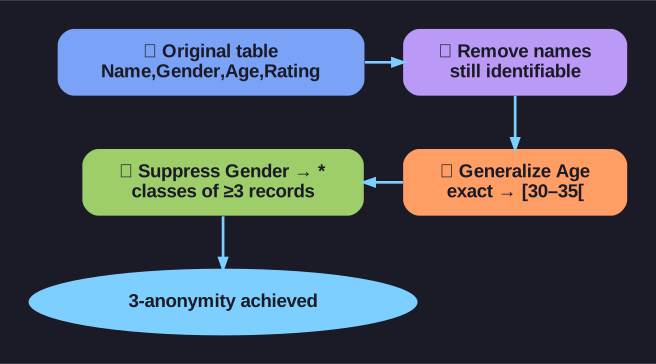
* The k-anonymity pipeline: cheap moves first, suppression last, until classes of size k form. *
Using a beer-rating dataset (Name, Gender, Age, Beer Rating) as the example:
- Original dataset — all attributes visible; classify them (Name = identifying, Gender/Age = QID, Beer Rating = sensitive).
- Remove names — the identifier is gone, but the data is still identifiable: a 32-year-old male with rating 8 may be unique.
- Generalize age — replace exact ages with ranges ([30–35[, [25–30[…). Better, but Gender + Age Range can still single out small groups.
- Suppress gender to
*— now each age range holds at least 3 indistinguishable records, forming equivalence classes. 3-anonymity achieved.
The progression shows the philosophy: you keep coarsening quasi-identifiers (generalize, then suppress) until everyone hides in a crowd of size ≥ k.
Tip: Notice the order — cheap moves first (remove, generalize), heavy hammer (suppress) last, because each step costs utility.
Go deeper:
 k-Anonymity (Sweeney, 2002) — generalization + suppression to equivalence classes.
- k-anonymity (Wikipedia) — worked walkthrough of the same process.