What are a testnet, a faucet, and a block explorer?
A testnet is a parallel blockchain whose tokens are worthless, used to practice and test for free; a faucet is a service that hands out those free testnet tokens; a block explorer is a website for inspecting any address, transaction, or block on a chain.
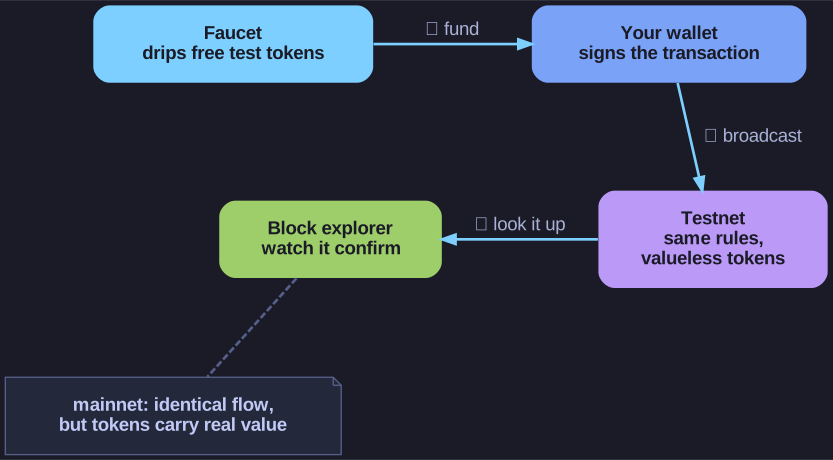
* Your first transaction, risk-free: faucet funds the wallet, the wallet broadcasts to the testnet, the explorer shows it confirm. *
Every major blockchain runs at least two kinds of network. The mainnet is the real one, where tokens carry real monetary value and mistakes cost money. A testnet mirrors the mainnet's behaviour but its tokens are deliberately valueless, so developers (and learners) can deploy contracts and send transactions risk-free before touching the real network. Since you still need tokens to pay testnet gas, faucets exist — websites that drip free testnet tokens to any address that asks, usually rate-limited to stop hoarding. Once you have sent a transaction, a block explorer such as Etherscan lets you look it up by its hash and watch it move from pending to confirmed — and, because the ledger is public, inspect any account's balance and history, every block's contents, and every deployed contract. The explorer is just a friendly window onto data any node already has; it runs the same lookup you could do yourself with your own node.
Go deeper:
 Networks — ethereum.org — mainnet vs testnets and where faucets fit in.
 Etherscan — the canonical block explorer: look up any transaction, address, or block.