What are "denying the antecedent" and "affirming the consequent," and why are they invalid?
Both are formal fallacies that misuse "if A then B": denying A to deny B, or affirming B to affirm A — neither follows.
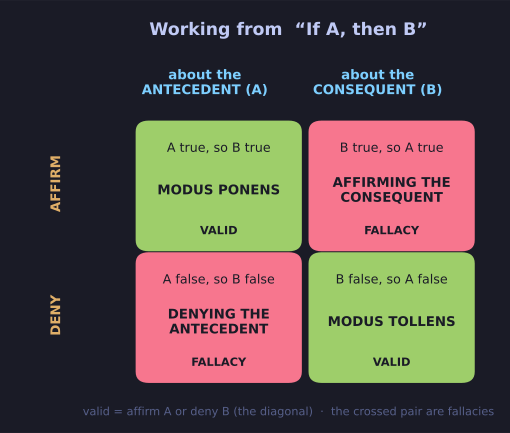
* The four moves on "If A, then B": affirming the antecedent and denying the consequent are valid; the crossed pair are the two formal fallacies. *
A conditional "If A, then B" only licenses one valid move forward (A is true → B is true, modus ponens) and one valid move backward (B is false → A is false, modus tollens). The two classic formal fallacies break exactly those rules:
- Denying the antecedent: (P1) If A, then B. (P2) Not-A. (K) Therefore not-B. — Invalid. "If it rains, the street is wet. It isn't raining. So the street isn't wet." But a burst pipe could wet the street; A isn't the only route to B.
- Affirming the consequent: (P1) If A, then B. (P2) B. (K) Therefore A. — Invalid. "If it rains, the street is wet. The street is wet. So it rained." Again, B can have other causes.
The shared mistake: treating "If A then B" as if it also meant "If B then A" (or "only if A, B"). A conditional is a one-way street; both fallacies try to drive it backward.
Tip: Valid: affirm the antecedent or deny the consequent. Fallacious: deny the antecedent or affirm the consequent. The fallacies are the "crossed" pair.