Quiz Entry - updated: 2026.07.30
What are infrastructure-based and ad-hoc (mesh) networks, and how do they differ?
Infrastructure-based networks rely on base stations that connect devices to a wired backbone. Ad-hoc (mesh) networks have no base stations, and devices organize themselves.
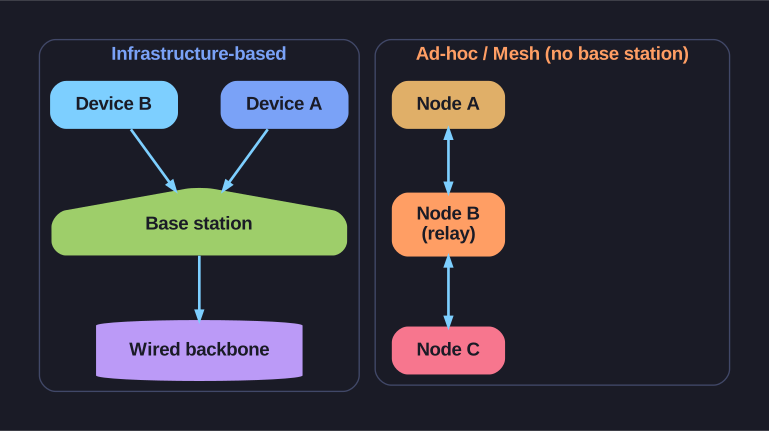
* Infrastructure routes via a base station; ad-hoc nodes self-organise. *

* Mesh topology: nodes self-organise, no base station. — Foobaz / Rehua, Public domain, via Wikimedia Commons. *
Infrastructure-based:
- A central base station manages all communication within its cell.
- Devices connect to the base station, which routes traffic to the wired network or to other cells.
- The base station handles handoff (also called handover): when a device moves from one cell to another, the connection is seamlessly transferred to the new base station.
- Examples: cellular networks (4G/5G), standard Wi-Fi (your home router).
- This is how the vast majority of daily wireless communication works.
Ad-hoc / Mesh:
- No base stations at all.
- Nodes can only communicate with other nodes within their own transmission range.
- Nodes self-organize into a network. They must discover neighbors, establish routes, and forward traffic cooperatively.
- If node A wants to reach node C but only node B is in range of both, B relays the message.
- Examples: Bluetooth piconets, disaster relief networks, vehicle-to-vehicle communication (V2V).
Security implication: Ad-hoc networks are harder to secure because there's no central authority. Every node must be trusted to relay traffic honestly, which opens the door to attacks like packet dropping or route manipulation.
Go deeper:
 Wireless ad hoc network (Wikipedia) — self-organising MANET topologies and how routing works without infrastructure.
- Wireless mesh network (Wikipedia) — the self-forming, self-healing multi-hop side: how 70+ routing protocols (AODV, OLSR, B.A.T.M.A.N.) stitch hops into a path with no base station.