What are Massive MIMO and beamforming in 5G NR, and why are they essential — especially for mmWave?
Massive MIMO puts many antenna elements (tens to hundreds) on one base station so it can carry several independent data streams on the same time-and-frequency resource; beamforming uses that array to focus the signal into a narrow beam aimed at each device. Together they multiply capacity and give mmWave enough gain to survive its heavy path loss.
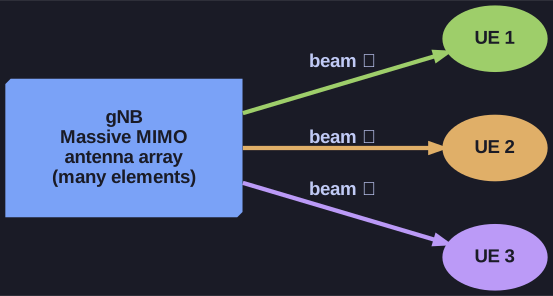
* One array, three steered beams — the streams share the same time & frequency, separated only in space (spatial multiplexing). *
Massive MIMO (Multiple Input, Multiple Output): an array of many transmit/receive antenna elements on one base station. It pays off two ways:
- Spatial multiplexing — several independent streams (to different users, or several layers to one user) ride the same time/frequency resource, separated only by their spatial path. More antennas → more parallel streams → more capacity, without extra spectrum.
- Array gain — combining many elements raises the effective signal strength.
Beamforming: instead of radiating power in every direction, the array adds its elements' signals in phase toward one direction, forming a focused beam (with nulls elsewhere). This concentrates energy where the device is and limits interference everywhere else. Two supporting functions make it adaptive:
- Beam Management — selecting, adjusting and switching beams as the device moves or the path changes.
- CSI (Channel State Information): the device measures the channel and sends a CSI Report, so the network knows how to steer and precode each beam.
Why this is essential for mmWave: mmWave (FR2) suffers severe attenuation and short range, so an omnidirectional antenna would waste most of its power. A focused beam recovers that lost link budget — beamforming is what makes mmWave usable at all. It also helps physically: mmWave wavelengths are millimetres, so hundreds of elements fit onto a single small panel.
What's new in 5G: of all the radio-layer functions, MIMO, Beam Management and CSI are the ones that vary most by generation — they are where 5G's physical layer differs most sharply from 2G/3G/4G, unlike timing, power control or framing, which every generation needs.
Tip: MIMO = more antennas → more parallel streams (capacity); beamforming = aim those antennas → more reach (coverage, especially mmWave). The tiny mmWave wavelength is exactly why hundreds of elements fit on one panel.
Go deeper:
 Massive MIMO (Electronics Notes) — how large antenna arrays separate users spatially, the capacity gain, and why 5G pushes antenna counts so high.
- 5G Massive MIMO in detail (ShareTechnote) — the array/beamforming engineering: how beams are formed and steered, with the antenna-pattern diagrams behind the concept.
- Beamforming (Wikipedia) — the underlying phased-array signal processing — adding element signals in phase to steer a beam (and form nulls) — with radiation-pattern figures (the carousel's diagram source for this card).