What are Privacy-Enhancing Technologies (PETs), and what is the trade-off they aim to optimise?
PETs are cryptographic and hardware techniques that enable useful computation on data while preserving the privacy of the data subjects. The trade-off is between social/economic utility (insights, aggregate statistics, AI training) and individual privacy (don't reveal raw personal data).
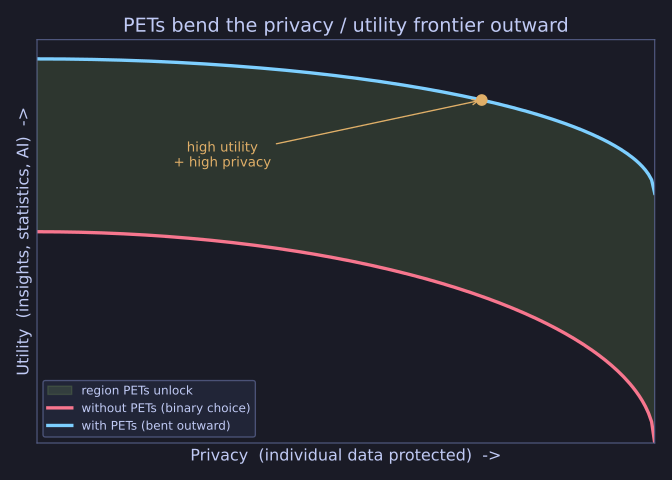
* Without PETs the privacy/utility frontier is a hard binary; PETs bend it outward so insight and privacy can coexist. *
The trade-off curve: without PETs, the choice is binary — either you share raw data and gain utility (but lose privacy) or you withhold data (lose utility, preserve privacy). PETs bend the curve outward — you can get useful aggregate results while individual records stay private.
Two main families:
| Family | What it does | Examples |
|---|---|---|
| Cryptographic PETs | Compute on encrypted data | Fully Homomorphic Encryption (FHE), Multi-Party Computation (MPC), Zero-Knowledge Proofs |
| Hardware-based PETs | Run computation in a tamper-resistant environment | Confidential Computing — TEEs (Intel SGX, AMD SEV, ARM TrustZone), TPM, programmable enclaves |
Specific cryptographic primitives:
- Fully Homomorphic Encryption (FHE) — perform arbitrary computation on ciphertexts; the result decrypts to the result of the same computation on plaintexts. Breakthrough: Gentry 2009. Performance has improved 1000× in a decade, still slow but practical for specific tasks.
- Multi-Party Computation (MPC) — multiple parties jointly compute a function without revealing inputs (e.g. computing the average salary across a group without anyone disclosing their own).
- Differential Privacy — add carefully calibrated noise to query results so no individual contributes detectable signal (Apple, Google use this for telemetry).
- Zero-Knowledge Proofs — prove statements about hidden data without revealing the data.
Confidential Computing (CC) — a hardware approach:
- Code + data live in an enclave that even the OS / cloud provider can't inspect.
- Useful for outsourcing computation to untrusted clouds.
- Trusted Execution Environments (TEEs) like Intel SGX, AMD SEV, AWS Nitro Enclaves.
Tip: The PET frontier is rapidly advancing. Apple uses differential privacy for QuickType suggestions; Google uses private aggregation for Chrome telemetry; Signal uses private contact discovery in Intel SGX. The "privacy + utility" trade-off is being pushed outward year by year.
Go deeper:
 Privacy-enhancing technologies (Wikipedia) — the families and the data-minimisation trade-off.