Quiz Entry - updated: 2026.07.30
What are RS and RA messages in the SLAAC (Stateless Address Autoconfiguration) process, and what multicast addresses do they use?
RS (Router Solicitation) is sent by a host to request an RA (Router Advertisement); RA is the router's response containing prefix and configuration info.
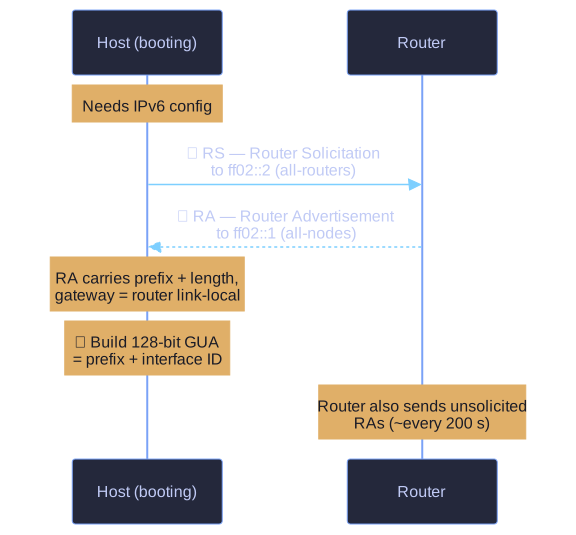
* SLAAC RS/RA exchange and its multicast addresses. *
Message flow:
| Message | Sender | Destination | Multicast Address |
|---|---|---|---|
| RS (Router Solicitation) | Host | All routers | ff02::2 |
| RA (Router Advertisement) | Router | All nodes | ff02::1 |
How the exchange works:
- Host boots up and needs IPv6 configuration
- Host sends an RS to ff02::2 (all-routers multicast) — "Are there any routers out there?"
- Router responds with an RA to ff02::1 (all-nodes multicast) — "Here's the prefix and config info"
- Host uses the RA information to create its GUA (Global Unicast Address)
Key detail: Routers also send unsolicited RAs every 200 seconds, even without an RS. But sending an RS lets the host get the information immediately instead of waiting.
Tip: ff02::1 = all nodes, ff02::2 = all routers. The host asks the routers (::2), the router tells all nodes (::1).
Go deeper:
 Neighbor Discovery Protocol (Wikipedia) — explains the Router Solicitation / Router Advertisement roles within NDP (Neighbor Discovery Protocol).