What are the characteristics and limitations of copper cabling?
Copper is cheap, easy to install, and has long been the most common LAN cabling — but its electrical signals suffer attenuation, EMI/RFI, and crosstalk.
Copper has long been the most common cabling in networks for a simple reason: it is inexpensive, easy to install, and conducts electricity with low resistance, so it carries signals well over the short distances typical of a local area network. The catch is that copper carries data as an electrical signal, and electrical signals are vulnerable to three kinds of degradation that you cannot fully escape — you can only design around them:
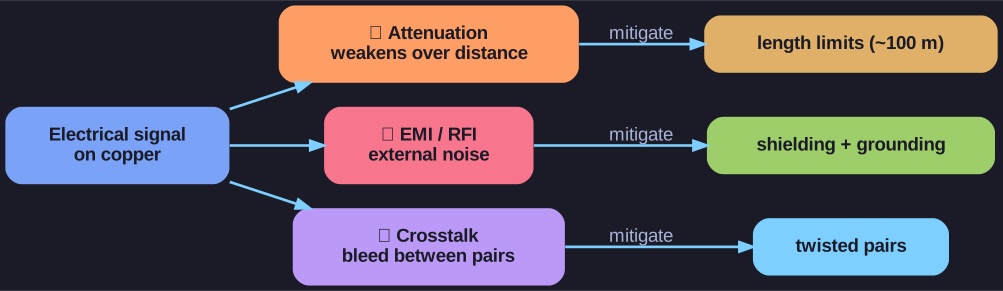
* Attenuation, EMI/RFI, and crosstalk each attack the electrical signal — countered by length limits, shielding, and twisting respectively. *
- Attenuation — the farther an electrical signal travels, the weaker it gets. Mitigated by strictly obeying cable-length limits (which is why Ethernet over copper is capped at about 100 m).
- EMI/RFI — Electromagnetic Interference and Radio Frequency Interference from outside sources (motors, fluorescent lights, radios) distort the signal. Mitigated by metallic shielding and grounding.
- Crosstalk — the signal on one wire pair bleeds into a neighboring pair inside the same cable. Mitigated by twisting the opposing wires of each circuit pair together so their fields cancel.
Why it matters: these three limitations are the root reason copper cabling has length limits, twisted pairs, and optional shielding in the first place — and the reason fiber (immune to EMI/RFI) is chosen when copper's weaknesses become a problem.
Go deeper:
-
 Twisted pair — Wikipedia — how twisting fights interference and why copper cabling has the design it does.
 -
Attenuation — Wikipedia — why a signal weakens with distance, the reason behind cable-length limits.
-
 Electromagnetic interference — Wikipedia — EMI/RFI from external sources and how shielding mitigates it.