What are the common types of static routes, and what is each used for?
Four formal types — standard (to a specific network), default (catch-all 0.0.0.0/0), floating (backup with a higher AD (Administrative Distance)), and summary (aggregate multiple subnets) — plus the host route (/32 or /128 to one device).
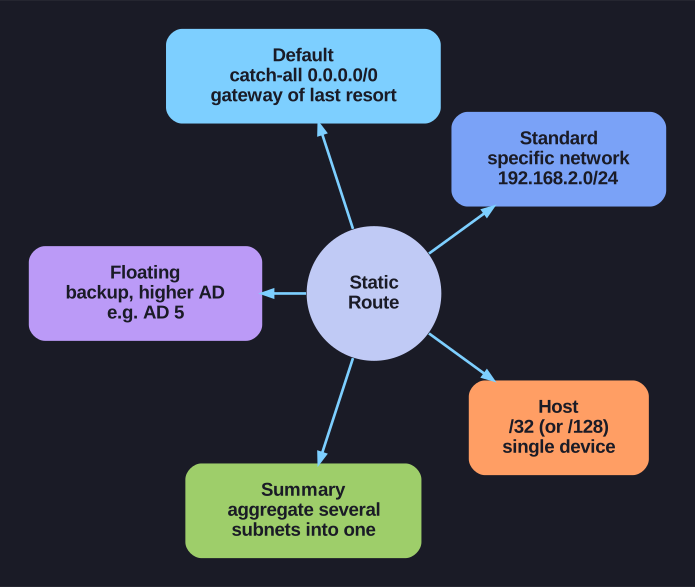
* The static-route types. *
Cisco groups static routes into four formal types — standard, default, floating, and summary. The host route (a /32 IPv4 or /128 IPv6 route to a single device) is a fifth practical variant the same ip route command produces; all of them come from one syntax and differ only in the destination prefix and administrative distance you give it.
| Type | Command Example | Use Case |
|---|---|---|
| Standard | ip route 192.168.2.0 255.255.255.0 172.16.2.2 |
Reach a specific remote network |
| Default | ip route 0.0.0.0 0.0.0.0 172.16.2.2 |
Gateway of last resort — catches all unmatched traffic |
| Floating | ip route 10.1.0.0 255.255.0.0 10.0.0.2 5 |
Backup route with higher AD — only active when primary fails |
| Summary | ip route 172.16.0.0 255.255.0.0 10.0.0.2 |
Aggregate multiple subnets into one route entry |
| Host | ip route 209.165.200.238 255.255.255.255 198.51.100.1 |
Route to a specific single device (/32 mask) |
Static routes are used even when dynamic routing is configured:
- Default route to the ISP (outside the dynamic routing domain)
- Stub networks with only one exit path
- Backup connections (floating static)
- When the admin needs explicit path control
Command syntax:
Router(config)# ip route network-address subnet-mask { ip-address | exit-intf [ip-address] } [distance]
Router(config)# ipv6 route ipv6-prefix/prefix-length { ipv6-address | exit-intf [ipv6-address] } [distance]
Go deeper:
 Static routing (Wikipedia) — the general static-route concept the five variants specialize.
- Default route (Wikipedia) — the 0.0.0.0/0 and ::/0 catch-all that is the default type.