Quiz Entry - updated: 2026.07.30
What are the components of the GSM core network (NSS), and what does each one do?
The core network consists of the MSC (call switching), HLR (permanent subscriber data), VLR (temporary visitor data), and AUC (authentication) — together they manage calls, mobility, and security.
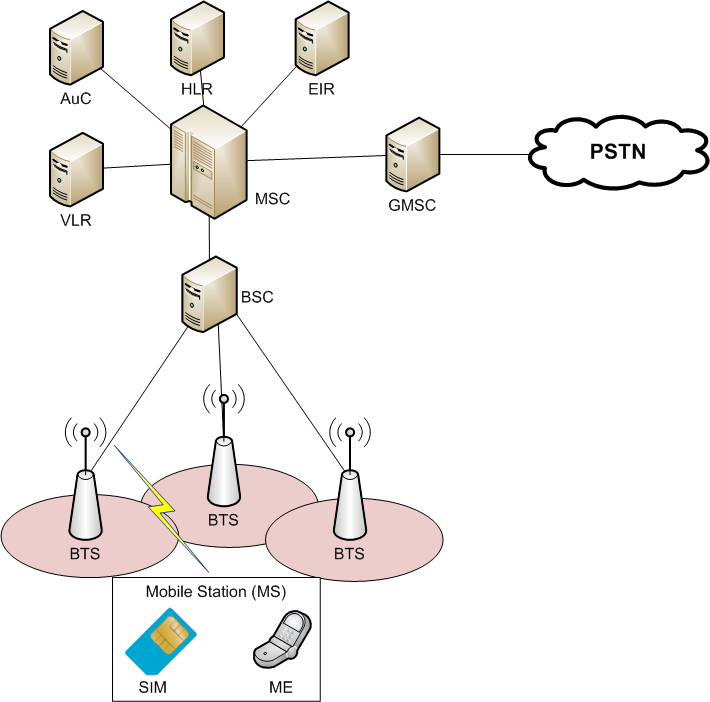
* GSM architecture: BSS radio side and NSS core. — Greno, Public domain, via Wikimedia Commons. *
| Component | Full Name | Function |
|---|---|---|
| MSC | Mobile Switching Center | Central switch — routes calls between BSCs, other MSCs, and external networks (PSTN) |
| HLR | Home Location Register | Permanent database — stores subscriber info (services, tariff, class) for all users registered with this operator |
| VLR | Visitor Location Register | Temporary database — caches info for subscribers currently visiting this MSC's area |
| AUC | Authentication Center | Generates authentication and encryption keys to verify subscriber identity |
How they work together:
- When your phone connects, the AUC verifies your identity via challenge-response
- The VLR (at the visited MSC) stores your temporary location info
- The HLR (at your home operator) is updated with your current MSC/VLR location
- The MSC handles the actual call routing and switching
Key insight: The HLR is the "single source of truth" for a subscriber. There's exactly one HLR entry per subscriber, but they might appear in multiple VLRs as they roam. Think of the HLR as your permanent address, and the VLR as the hotel guest register.
Go deeper:
 GSM network architecture (Electronics Notes) — a block-diagram walkthrough of how the BSS (BTS/BSC) and NSS (MSC, HLR, VLR, AuC, EIR) interconnect, with the interfaces between them.