What are the eight "intellectual standards" of good thinking, and roughly in what order do they build on each other?
Clarity, accuracy, precision, relevance, depth, consistency, breadth, and logic — a stack where each later standard can still fail even when the earlier ones are met.
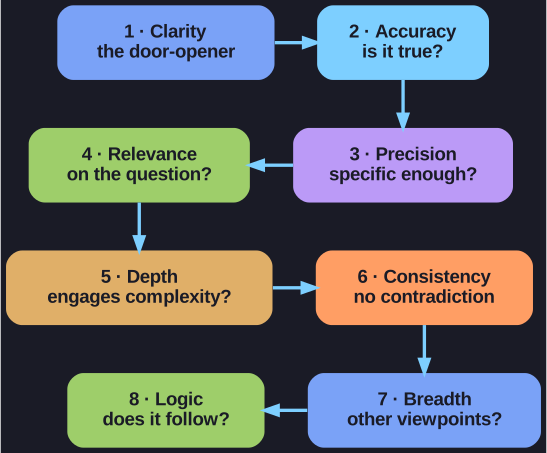
* The eight standards as a cumulative chain — each can still fail even when the earlier ones are met; clarity is the door-opener. *
These are the Paul–Elder intellectual standards: quality-assurance norms you apply to any statement or piece of reasoning. The clever part is that they're partly cumulative — a statement can pass one and still flunk the next:
| Standard | What it checks | Can pass the previous yet fail this |
|---|---|---|
| Clarity (Klarheit) | Is it understandable? The "door-opener" | — |
| Accuracy (Richtigkeit) | Is it actually true? | "All dogs weigh over 50 kg" is clear but false |
| Precision (Exaktheit) | Is it specific enough? | "Ueli is overweight" is clear and true but vague (how much?) |
| Relevance (Relevanz) | Does it bear on the question? | Can be clear, true, precise — yet off-topic |
| Depth (Tiefgang) | Does it engage the complexity? | Can be all the above yet superficial |
| Consistency (Konsistenz) | Do thoughts/words/deeds agree? A minimal requirement for truth | — |
| Breadth (Vernetzung) | Are other viewpoints considered? | Can be deep yet one-sided |
| Logic (Logik) | Does the conclusion follow validly, free of fallacy? | — |
Tip: Clarity is the "door-opener": without it you can't even assess whether something is accurate or relevant. So it comes first by necessity, not convention.
Go deeper:
 Critical thinking (Wikipedia) — lists the intellectual standards (clarity, accuracy, relevance...).
- Critical thinking (Stanford Encyclopedia of Philosophy) — the standards in their philosophical setting.