Quiz Entry - updated: 2026.07.30
What are the five key wireless challenges?
The five wireless challenges are: multi-user support, high data rate demands, limited coverage, spectrum limitations, and interference with other users.
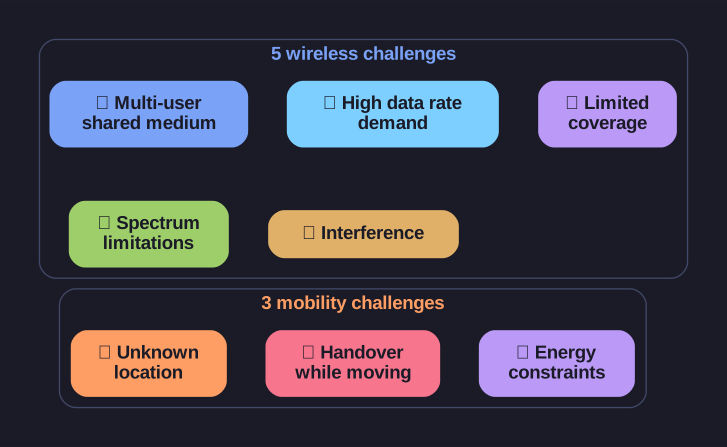
* The five wireless challenges plus three mobility challenges. *
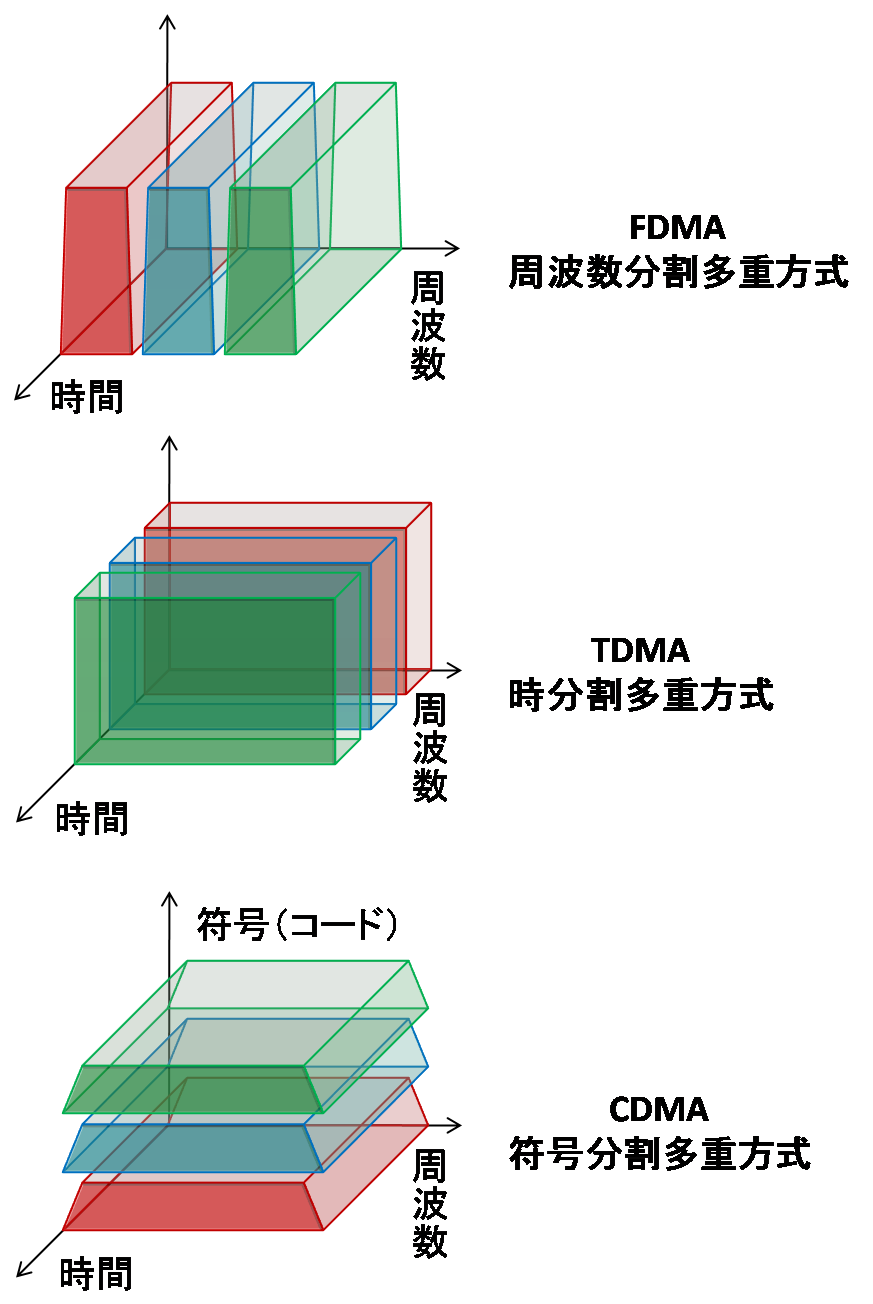
* FDMA, TDMA and CDMA share one medium differently., CC BY-SA 3.0, via Wikimedia Commons. *
1. Multi-user Operation (Mehrbenutzerbetrieb):
- Air is a shared medium. Unlike a cable where each device gets its own wire, everyone broadcasts into the same space.
- The network must support many users transmitting simultaneously without garbling each other's signals.
- This is solved by multiple access techniques: TDMA (time slots), FDMA (frequency bands), CDMA (codes), OFDMA (subcarriers).
2. High Data Rate:
- Users demand ever-increasing speeds. Streaming 4K video requires far more bandwidth than a voice call.
- The Shannon-Hartley theorem sets a theoretical limit on how much data you can push through a given bandwidth with a given signal-to-noise ratio.
3. Limited Coverage (Hohe Abdeckung):
- Transmission is only possible within a certain range, determined by transmit power and receiver sensitivity.
- Higher frequencies (like 5G mmWave) offer more bandwidth but shorter range. There's always a tradeoff.
4. Spectrum Limitations (Spektrumbeschränkungen):
- Radio spectrum is finite and regulated by international agreements.
- Governments auction frequency bands to operators. This is why mobile licenses cost billions of euros.
- Unlicensed bands (like 2.4 GHz for Wi-Fi) are free but crowded.
5. Interference (Störanfälligkeit):
- One device's transmission can disrupt another's. Unlike wired networks where signals stay in their cable, wireless signals spread in all directions.
- This is fundamentally different from wired networks and requires careful coordination.
Go deeper:
 Multiple access schemes — FDMA / TDMA / CDMA / OFDMA (Electronics Notes) — a worked explainer of each scheme and the requirements any of them must meet, deeper than the encyclopedia definition.
 Hidden / exposed terminal problem — RTS/CTS handshake (YouTube) — animates why a shared medium garbles signals when senders can't hear each other (the hidden-node collision), and how the RTS/CTS reservation fixes it.
- Channel access method (Wikipedia) — kept for the image carousel; the side-by-side view of how FDMA/TDMA/CDMA/OFDMA each slice the medium.