Quiz Entry - updated: 2026.07.30
What are the five steps of the Provokationstechnik (Provocation Technique)?
Falsification, Reversal, Ideal Case, Exaggeration, and Removing Assumptions — five ways to provoke new thinking.
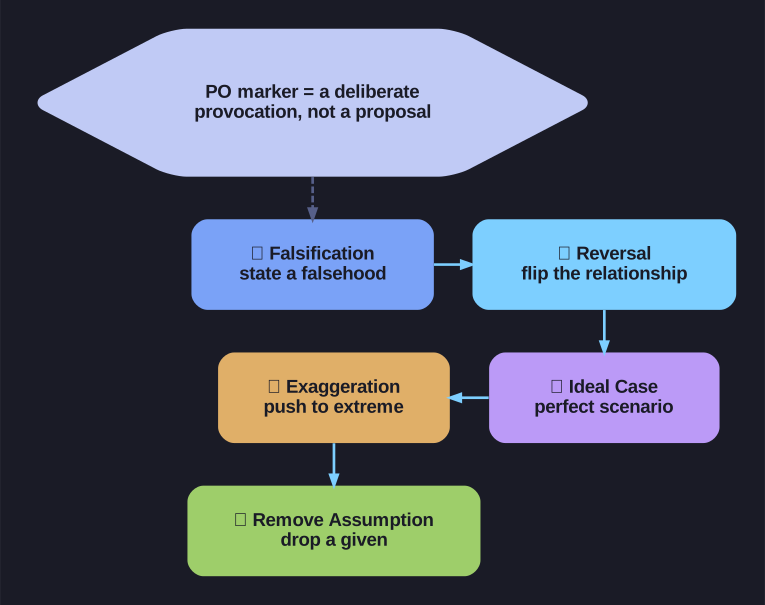
* The five provocation moves, all marked by de Bono's "PO". *
| Step | Method | Description | Example |
|---|---|---|---|
| 1 | Falsification (Verfälschung) | State something obviously false about the topic | "The basketball court is crooked" |
| 2 | Reversal (Umkehrung) | Reverse the normal relationship | "Students teach the professor" / "The dog walks the human" |
| 3 | Ideal Case (Idealfall) | Imagine the perfect, unrealistic scenario | "There are no losers in the game" / "The battery is never empty" |
| 4 | Exaggeration (Übertreibung) | Take a property to an extreme | "The car is 20 meters long" / "A day has 50 hours" |
| 5 | Removing Assumptions (Aufhebung von Annahmen) | Drop a fundamental assumption | "The phone doesn't need electricity" / "Students don't need teachers" |
How to use it:
- Pick one of the five provocation types
- Apply it to your problem to create a deliberately absurd statement
- Don't dismiss it — instead, use the provocation as a stepping stone
- Ask: "What useful idea does this provocation lead to?"
The provocations can lead to real innovations:
- "Students teach the professor" → peer learning, flipped classroom
- "Phone doesn't need electricity" → energy harvesting, solar-powered devices
- "No losers in the game" → cooperative game design, gamification
Tip: The word "PO" (Provocative Operation) is de Bono's marker — when you say "PO: passwords are unnecessary," everyone knows it's a deliberate provocation, not a serious proposal.
Go deeper:
 Po (lateral thinking) (Wikipedia) — de Bono's "PO" provocation marker, in his own framing.