What are the formal fallacies "denying the antecedent" and "affirming the consequent"?
Two invalid conditional forms: denying the antecedent (if A→B, not-A, ∴ not-B) and affirming the consequent (if A→B, B, ∴ A).
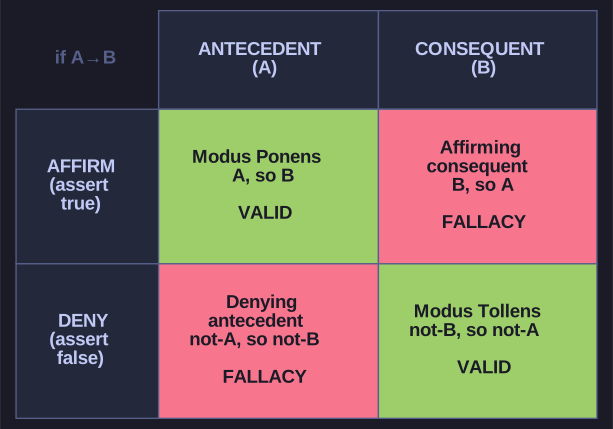
* Affirm the antecedent or deny the consequent = valid; affirm the consequent or deny the antecedent = fallacy. *
These look like the valid conditional forms but are formal fallacies — invalid argument structures:
- Denying the antecedent: (P1) If A, then B. (P2) Not-A. (K) Therefore not-B. — Invalid: A's absence doesn't rule out B, because B might be brought about some other way.
- Affirming the consequent: (P1) If A, then B. (P2) B. (K) Therefore A. — Invalid: B being true doesn't prove A, because something else could have made B true.
Example of affirming the consequent: "If it rained, the street is wet. The street is wet. Therefore it rained." — but a burst pipe could also explain the wet street.
Tip: Pair them with the valid forms: modus ponens (affirm A → get B) and modus tollens (deny B → get not-A) are valid; affirm B or deny A are the fallacies. Only the antecedent-affirming and consequent-denying directions are safe.
Go deeper:
 Affirming the consequent (Wikipedia) — why B being true does not establish A.
- Denying the antecedent (Wikipedia) — why not-A does not establish not-B.