Quiz Entry - updated: 2026.07.30
What are the four basic characteristics of a reliable network architecture?
Fault Tolerance, Scalability, Quality of Service (QoS), and Security.
These four are the qualities a network must deliver to meet user expectations — together they're the yardstick for whether an architecture is "reliable." A useful way to remember why each matters: fault tolerance keeps it running, scalability lets it grow, QoS keeps the important traffic smooth, and security keeps it trustworthy. Drop any one and users notice.
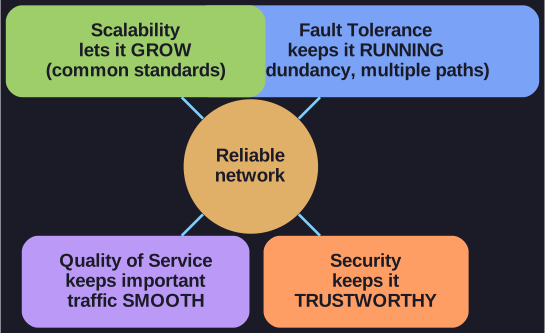
* Four pillars of a reliable network: fault tolerance (runs), scalability (grows), QoS (smooth), security (trustworthy). *
- Fault Tolerance: Limits the impact of failures by using redundancy and multiple paths, so a single broken link or device doesn't take the whole network down.
- Scalability (ability to grow): Can expand quickly to support new users and applications without degrading service for existing users — achieved by following common standards.
- Quality of Service (QoS): Prioritizes time-sensitive traffic (e.g., voice and video over web browsing) so the most important data still gets through when the network is congested.
- Security: Protects both the network infrastructure (the devices) and the information travelling across it from unauthorized access and tampering.
Go deeper:
 The Network as a Platform — Network Architecture (Cisco Press) — the exact ITN source: names and explains all four characteristics (Fault Tolerance, Scalability, QoS, Security) in one place.
- Computer network (Wikipedia) — broad context on network architecture and design goals.