Quiz Entry - updated: 2026.07.30
What are the four fundamental elements of any wireless network?
Every wireless network is built from four elements: wireless devices, base stations, wireless links, and network infrastructure.
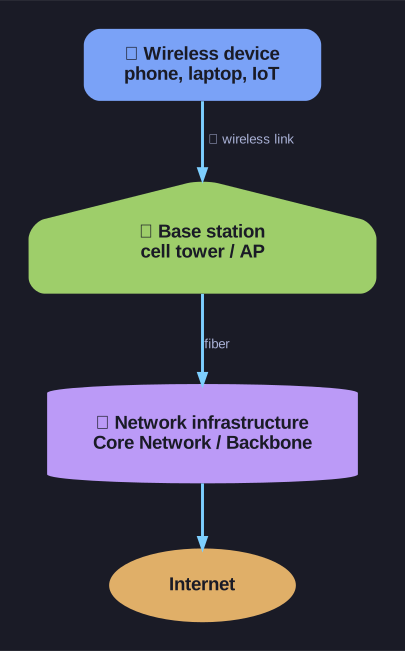
* The four elements: device, link, base station, infrastructure. *
1. Wireless Devices (Drahtlose Geräte):
- The end-user devices: smartphones, laptops, IoT sensors.
- These run the actual applications.
- Can be stationary or mobile. Important distinction: wireless does not automatically mean mobile. A desktop PC with a Wi-Fi adapter is wireless but not mobile.
2. Base Station (Basisstation):
- The bridge between the wireless world and the wired world.
- Examples: cell towers, Wi-Fi access points, WiMAX base stations.
- Connected to the wired network infrastructure via cable (usually fiber).
- Acts as a relay, forwarding packets between the wired network and wireless devices within its coverage area.
3. Wireless Link (Übertragungskanal):
- The radio connection between devices and the base station.
- A multiple access protocol coordinates which device gets to transmit when, since air is a shared medium.
- Different technologies offer different data rates and transmission distances.
4. Network Infrastructure (Netzwerkinfrastruktur):
- The wired backbone connecting base stations to each other and to the internet.
- In mobile networks, this is called the Core Network (Kernnetz).
- In wired internet, it's called the Backbone.
Tip: Think of it like a postal system. Devices are the people sending mail, the base station is the local post office, the wireless link is walking to the post office, and the network infrastructure is the postal truck network connecting all post offices.
Go deeper:
 Wireless network (Wikipedia) — how the device → link → base-station → backbone building blocks recur across PAN, LAN and cellular networks.