Quiz Entry - updated: 2026.07.30
What are the four main "broadening" methods for de-identification, ordered by sophistication?
Data aggregation, k-anonymity, l-diversity, and t-closeness — each fixes a weakness left by the previous.
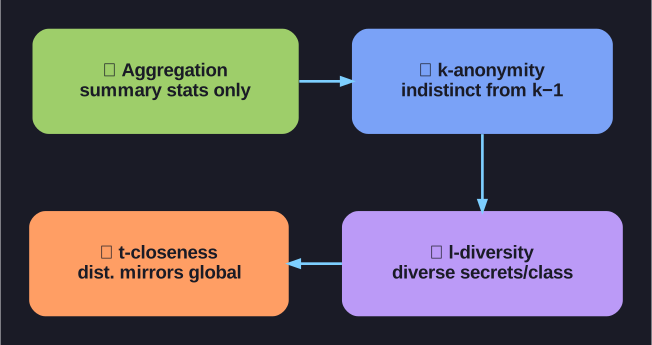
* The broadening progression — each model patches a hole the previous one leaves open. *
- Data Aggregation — combine individual points into summary statistics, removing granular detail (report averages, not rows).
- K-anonymity — ensure each record is indistinguishable from at least k-1 others on its quasi-identifiers.
- L-diversity — extend k-anonymity so each equivalence group has diverse sensitive values (fixes the homogeneity attack).
- T-closeness — require the distribution of the sensitive attribute within each group to mirror the overall distribution (fixes skewness/similarity attacks).
They form a progression: each model patches a re-identification or inference hole that the previous one leaves open. Stronger guarantees generally cost more utility.
Tip: Read it as an arms race: k-anonymity → homogeneity attack → l-diversity → skewness/similarity attack → t-closeness.
Go deeper:
 l-diversity (Wikipedia) — how l-diversity fixes k-anonymity's homogeneity gap.
- t-closeness (Wikipedia) — the final step that fixes skewness/similarity.