Quiz Entry - updated: 2026.07.30
What are the four main components of the UMTS network architecture?
UMTS consists of UE (User Equipment), UTRAN (radio access network), CN (Core Network), and the UMTS-PLMN (the operator's complete mobile network).
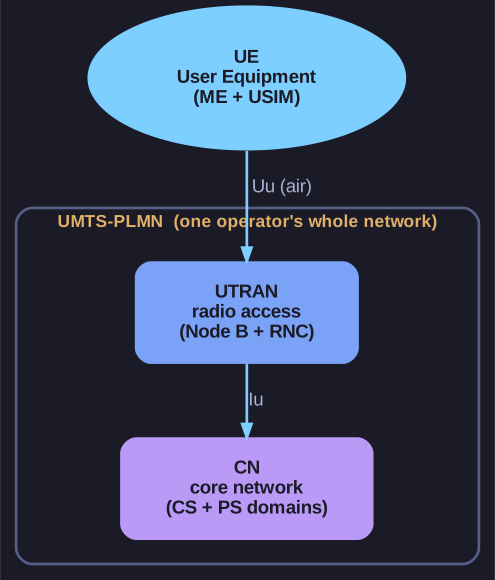
* The four pieces and how they nest: the UE talks to the UTRAN over the air, the UTRAN connects to the CN, and the PLMN is the operator boundary that encloses UTRAN + CN. *
| Component | Full Name | Role |
|---|---|---|
| UE | User Equipment | The mobile device (phone, laptop, router) — equivalent to GSM's MS |
| UTRAN | UMTS Terrestrial Radio Access Network | All radio-related infrastructure — handles the wireless connection |
| CN | Core Network | Fixed network for routing, switching, and subscriber management |
| UMTS-PLMN | Public Land Mobile Network | One network operator's complete UMTS network (its UTRAN + CN together) — each operator runs its own PLMN |
Key difference from GSM: UMTS was designed from the ground up to handle both voice and data as first-class citizens, whereas GSM was voice-first with data bolted on later (GPRS). This is reflected in the architecture having parallel circuit-switched and packet-switched domains in the core network.
Go deeper:
 3G UMTS Network Architecture (Electronics Notes) — walks the UE / UTRAN / core split element by element, including the CS and PS domains and shared HLR/AUC; richer than the encyclopedia overview.
- UMTS (Wikipedia) — kept for the canonical standard overview and its architecture diagram.