What are the four phases a mobile phone goes through from power-on to being able to send data?
Power on → network and frequency selection → registration (Location Update) → data channel setup.
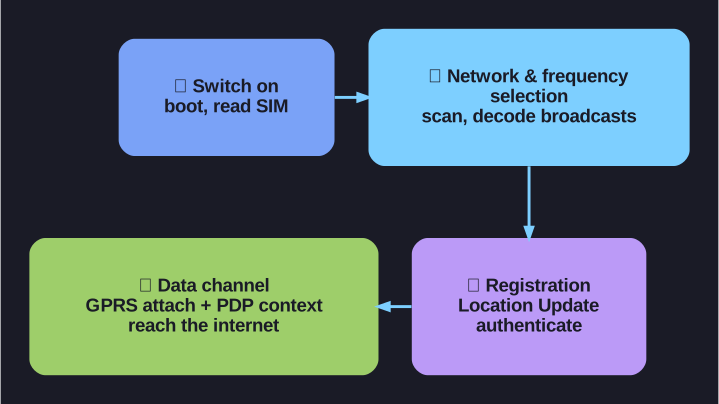
* Power-on to data in four phases. *
The pipeline:
| Phase | What happens |
|---|---|
| 1. Telefon einschalten | The phone boots, reads the SIM |
| 2. Netz- und Frequenzwahl | Scan frequencies, find cells, decode their broadcasts, pick a network |
| 3. Einbuchung (Location Update) | Register with the network — authenticate and let it know where you are |
| 4. Aufbau Datenkanal | Set up the data path (for 2.5G+: GPRS attach + PDP context to reach the internet) |
Why this matters: Most people have a good mental model of what happens when a laptop joins Wi-Fi or opens a TCP connection — but almost nobody knows the equivalent story for mobile networks, even though we carry these devices everywhere. This sequence is that story for 2G/3G.
Going deeper: The classic walkthrough of this whole sequence is Harald Welte's CCC talk "What happens on a protocol level when I switch on my phone?" (Easterhegg 2018, 62 min, freely available at https://media.ccc.de/v/ARMP3D) — step by step through the real protocol messages, aimed at people who know TCP/ARP but not mobile.
Go deeper:
 Harald Welte — What happens on a protocol level when I switch on my phone? (CCC, 2018) — the canonical 62-min live walkthrough of exactly these four phases in real protocol messages, for people who know TCP/ARP but not mobile.
 OsmocomBB (Wikipedia) — Welte's free GSM baseband (L1–L3 phone-side stack) that lets you actually run and trace this power-on sequence on a real handset.