Quiz Entry - updated: 2026.07.30
What are the four types of cloud computing?
Public, Private, Hybrid, and Custom clouds.
The four types differ mainly in who can use the cloud and who it's built for — a spectrum from fully open to highly tailored. Choosing among them is a trade-off between cost/convenience (public) and control/compliance (private), with hybrid and custom existing to balance the two for specific needs.
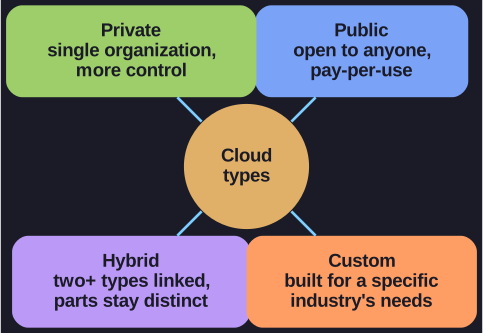
* Four cloud types on a spectrum from fully open (public) to highly tailored (custom). *
- Public Cloud: Available to the general public on a pay-per-use model or for free — cheapest and easiest, but you share infrastructure with everyone else.
- Private Cloud: Intended for a single organization or entity (e.g., a government) — more control and security, at higher cost.
- Hybrid Cloud: Two or more cloud types connected through the same architecture, each part remaining distinct — used to keep sensitive workloads private while bursting other work to the public cloud.
- Custom Cloud: Built to meet a specific industry's needs (e.g., healthcare or media), and can be private or public.
Cloud computing = storing files or using applications on servers over the Internet, made possible by data centers (large facilities that smaller companies lease capacity from instead of building their own).
Go deeper:
 The NIST Definition of Cloud Computing (SP 800-145) — the authoritative source defining the deployment models (private, community, public, hybrid).
- The Changing Network Environment (Cisco Press) — Cisco's own framing naming the exact four types on this card: private, public, hybrid, and custom.
- Cloud computing (Wikipedia) — overview of public/private/hybrid models.