Quiz Entry - updated: 2026.07.30
What are the main factors in the FAIR (Factor Analysis of Information Risk) model, and how do they fit together?
Risk = Loss Event Frequency (LEF) × Loss Magnitude (LM). LEF breaks down further into Threat Event Frequency × Vulnerability; LM into Primary + Secondary loss.
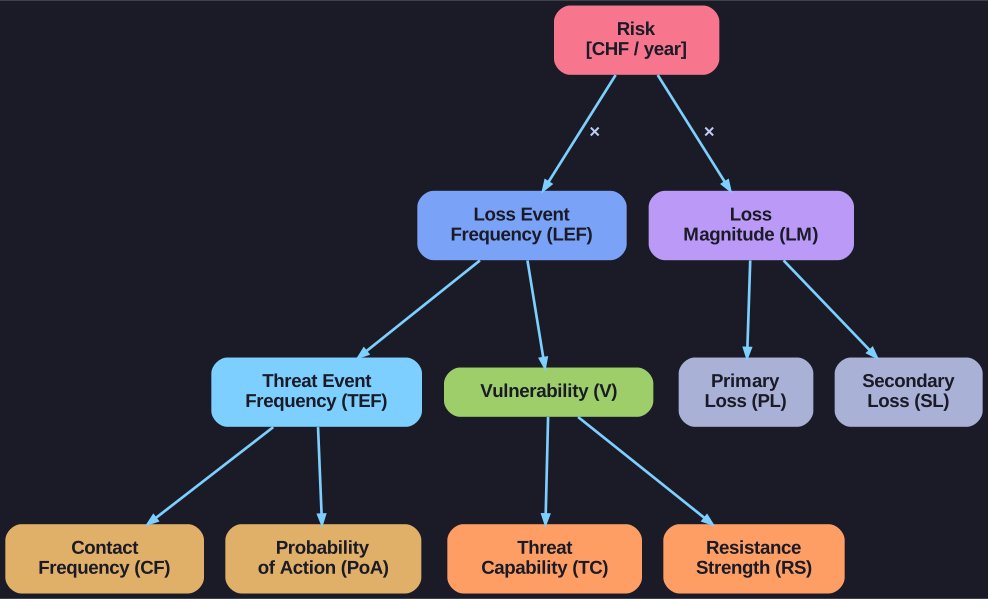
* The FAIR factor tree: Risk = Loss Event Frequency × Loss Magnitude, each recursively decomposed. *
The full decomposition:
                                Risk (CHF/year)
                               /                \
       Loss Event Frequency [#/year]      Loss Magnitude [CHF/event]
       (LEF)                              (LM)
       /          \                       /              \
Threat Event Freq  Vulnerability        Primary Loss   Secondary Loss
(TEF) [#/year]     (V) [%]              (PL)           (SL)
   /     \            /        \
Contact   Probab.   Threat       Resistance
Freq (CF) of Action Capability   Strength (RS)
          (PoA)    (TC)
Mapped to the conceptual blocks:
- Exposure drives Contact Frequency × Probability of Action → TEF.
- Threat actor capability vs Controls resistance → Vulnerability.
- TEF × V → how often a loss actually happens.
- Primary Loss = direct cost (incident response, downtime). Secondary Loss = consequences (fines, reputation, lawsuits, churn).
Why FAIR matters: it makes cyber risk defensible in CHF. Instead of "this is a Medium-High risk", you can say "CHF 195k most likely annual loss, 90th-percentile CHF 549k" — and that's the language CFOs and boards understand.
Go deeper:
 What is FAIR (FAIR Institute) — the standards body's overview of FAIR as the quantitative model for cyber risk.
- Factor analysis of information risk (Wikipedia) — the factor tree in text: LEF (TEF × vulnerability) and loss magnitude.