What are the minimum and maximum Ethernet frame sizes, and what happens to frames outside these limits?
Valid range is 64–1518 bytes (preamble/SFD excluded). Anything smaller than 64 is a runt and is dropped; an otherwise-valid frame larger than 1518 is a giant. "Jumbo frames" are a different thing — an intentional, must-be-enabled feature, not just "anything over 1518".
A standard Ethernet frame is 64 to 1518 bytes, measured from the destination MAC (Media Access Control) address through the FCS (Frame Check Sequence) — the 8-byte preamble plus Start Frame Delimiter (SFD) used only for timing are not counted. The terms for malformed frames trip people up, so keep them straight:
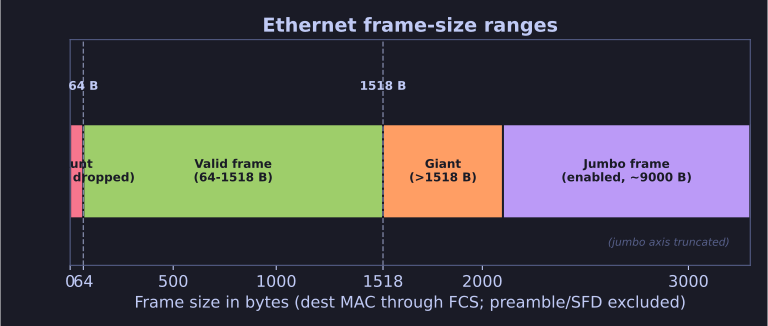
* The valid band is 64-1518 B; below it is a runt, an otherwise-valid frame above it is a giant, and a jumbo frame is a separate must-be-enabled feature. *
- Runt — a frame smaller than 64 bytes. If it was produced by a collision it is also called a collision fragment. Runts are invalid and the receiver discards them.
- Giant — an otherwise-valid frame larger than 1518 bytes. A baby giant is one only slightly over the limit, most commonly a frame carrying an 802.1Q VLAN tag (~1522 bytes). A plain device that hasn't been told to accept them will drop a giant.
- Jumbo frame — not simply "any frame over 1518". This is an intentional, vendor-supported feature (often up to ~9000 bytes) that must be explicitly enabled on both ends and on every switch in the path. It is used to cut overhead on Gigabit/10-Gig links (e.g. iSCSI, NFS storage). Disabled by default.
- Bad FCS / CRC-error frame — a frame inside the valid 64–1518 range but with a checksum mismatch. It is just an error frame; it is not called a runt or giant. (A runt-with-bad-FCS from a collision is the collision fragment above.)
Why 64 bytes minimum? On legacy half-duplex Ethernet the slot time had to be long enough for CSMA/CD (Carrier Sense Multiple Access with Collision Detection) to notice a collision before a sender finished transmitting; 64 bytes guaranteed that, so any shorter frame must be a collision remnant.
Go deeper:
-
 Jumbo frame (Wikipedia) — why a jumbo frame (commonly up to ~9000 B) is a deliberately enabled feature, distinct from an oversized "giant".
 -
Ethernet frame — including runt frames (Wikipedia) — the minimum/maximum length rules and the definition of a runt as a sub-64-byte frame.