What are the parts of the Toulmin model of argument, and what question does each answer?
Data → Conclusion, licensed by a Warrant, which is itself propped up by Backing — with an optional Rebuttal that flags exceptions.
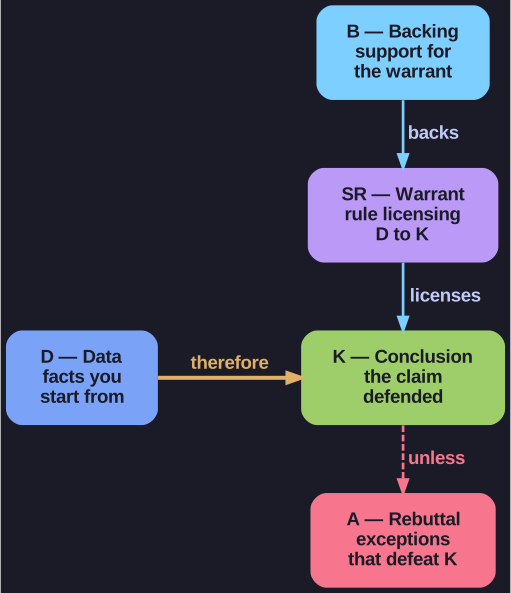
* The Toulmin model: Data leads to a Conclusion, licensed by a Warrant that Backing supports; a Rebuttal marks the exceptions. *
The Toulmin schema (Stephen Toulmin) is a map of how a real argument hangs together — richer than "premises → conclusion" because it exposes the often-hidden rule that connects them:
| Part (German) | Role | The question it answers |
|---|---|---|
| D — Data (Daten) | The facts/evidence you start from | "How do you get to that?" |
| K — Conclusion (Konklusion) | The claim you're defending | (the thing being argued for) |
| SR — Warrant (Schlussregel, Prinzip) | The general rule licensing D → K | "How do you get across to it?" |
| B — Backing (Begründung, Stützung) | Support for the warrant itself | "Why should that rule hold?" |
| A — Rebuttal (Ausnahmebedingung) | Conditions under which K does not follow | (the exception that defeats it) |
The point of the model: an argument isn't just data and a conclusion. There's always a warrant — a bridging rule — and that warrant usually needs its own backing. Making the warrant explicit is where most disagreements actually live.
Tip: D and K are the visible parts; SR is the bridge between them and B is what holds the bridge up. The Rebuttal (A) is what stops a warrant from being treated as absolute.
Go deeper:
 Stephen Toulmin & the Toulmin model — Wikipedia — the six components of his argument model and where it came from.