What are the pilot signal, the Reporting Range, and the Active Set in UMTS handover control?
Every NodeB transmits a pilot signal (30 dBm) that mobiles measure; the Reporting Range decides when a new link is considered for handover; the Active Set is the set of NodeBs the mobile is currently connected to.
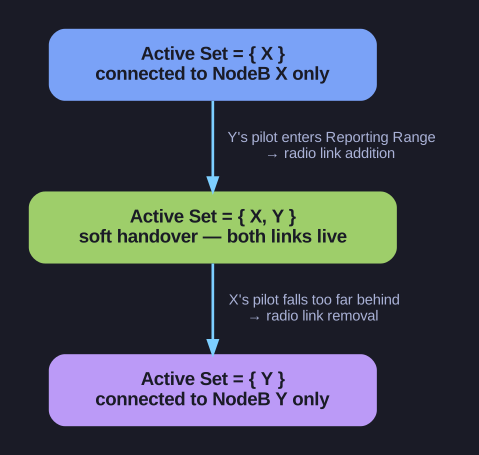
* The Active Set as a rolling membership list as the mobile moves NodeB X → NodeB Y. *
The three concepts (scenario: a mobile moves from NodeB x to NodeB y):
| Concept | Meaning |
|---|---|
| Pilot signal | A reference signal transmitted by every NodeB (at 30 dBm) — the "lighthouse" the mobile uses to judge each cell's signal strength |
| Reporting Range (RR) | The threshold that decides when a new link is considered for handover — when a candidate's pilot comes within the RR of the strongest one |
| Active Set | The set of NodeBs the mobile is currently connected to (during soft handover, more than one) |
Handover control defines the Active Set: as the mobile moves, NodeB y's pilot grows stronger; once it enters the Reporting Range, y is added to the Active Set (radio link addition). When x's pilot falls too far behind, x is removed (radio link removal). The handover is not one atomic switch but a gradual reshaping of the Active Set.
Tip: Think of the Active Set as a rolling membership list — soft handover means the list temporarily has 2+ members, and "handover complete" means the old cell dropped off the list.
Go deeper:
 Soft handover (Wikipedia) — the simultaneous multi-cell connection (the Active Set) that pilot measurement and the Reporting Range manage.