What are the properties and limitations of wireless media?
Wireless modulates radio/microwave signals to carry bits, giving maximum mobility — but it's limited by coverage area, interference, weaker security, and the fact that it's a shared half-duplex medium.
Wireless media carries electromagnetic signals — the binary 1s and 0s — through the air using radio or microwave frequencies, with no cable at all. Its overwhelming advantage is mobility: a device can move around and stay connected, which is why the number of wireless-enabled devices keeps climbing. But removing the cable trades away several things, and these four limitations are the price:
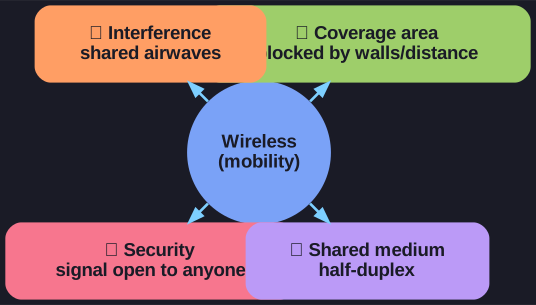
* Mobility comes at the cost of limited coverage, shared-air interference, weaker security, and a half-duplex shared medium. *
- Coverage area — the usable range is significantly affected by the physical environment (walls, distance, building materials), so signal can fade or drop in places.
- Interference — wireless shares the airwaves and is easily disrupted by many common devices (microwave ovens, cordless phones, neighboring networks).
- Security — because no physical access is needed to reach the signal, anyone within range can potentially intercept it; this is why strong encryption and access policies are essential.
- Shared medium — Wireless LANs (WLANs) operate in half-duplex, so only one device can send or receive at any instant. The medium is shared among all users, so the more devices that are active, the less bandwidth each one gets.
Why it matters: these constraints explain why wired links are still preferred for stationary, high-performance, or security-sensitive devices, while wireless is chosen where mobility wins.
Go deeper:
-
 Wireless LAN — Wikipedia — the shared, half-duplex medium (CSMA/CA) and the coverage/interference realities of WLANs.
 -
 Wireless — Wikipedia — broad reference on transmitting information through the air without a guided medium.