Quiz Entry - updated: 2026.07.30
What are the significant fields in an IPv4 packet header and their functions?
The key fields are Source and Destination IPv4 addresses (used by every router to forward), plus TTL (hop limit, discarded at 0), Protocol (next-layer ID), Version, DS (QoS), and Header Checksum.
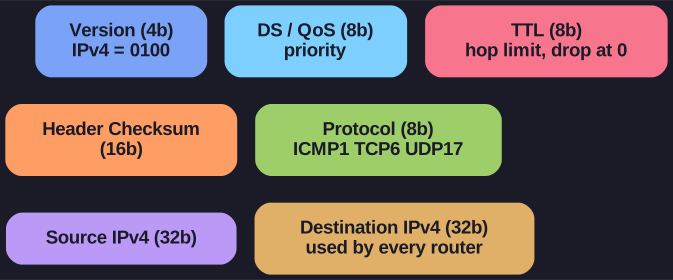
* The fields routers care about most — Source/Destination addresses, plus TTL, Protocol, DS and the header checksum. *
IPv4 Header Fields (minimum 20 bytes):
| Field | Size | Function |
|---|---|---|
| Version | 4 bits | Identifies IP version (0100 for IPv4) |
| Differentiated Services (DS) | 8 bits | QoS priority (formerly ToS - Type of Service) |
| Header Checksum | 16 bits | Detects corruption in the IPv4 header |
| Time to Live (TTL) | 8 bits | Hop count limit; decremented at each router; packet discarded when TTL=0 |
| Protocol | 8 bits | Identifies next level protocol (ICMP=1, TCP=6, UDP=17) |
| Source IPv4 Address | 32 bits | Sender's IP address |
| Destination IPv4 Address | 32 bits | Receiver's IP address |
Additional fields: IHL, Total Length, Identification, Flags, Fragment Offset, Options
Key insight: The two most important fields are Source and Destination addresses - they are used by all Layer 3 devices to make forwarding decisions.
Go deeper:
 NetworkLessons — IPv4 Packet Header — every field explained with a real Wireshark capture.
- RFC 791 §3.1 — Internet Header Format — the authoritative bit-level header definition.
- Wikipedia — IPv4 (header) — header diagram and field reference.