Quiz Entry - updated: 2026.07.30
What are the six FHRP protocol options, and what distinguishes each one?
The main options are HSRP (Hot Standby Router Protocol) (Cisco, active/standby), HSRP for IPv6, VRRPv2 (Virtual Router Redundancy Protocol v2) (open standard, IPv4), VRRPv3 (open standard, IPv4+IPv6), GLBP (Gateway Load Balancing Protocol) (Cisco, load balancing), and IRDP (legacy).
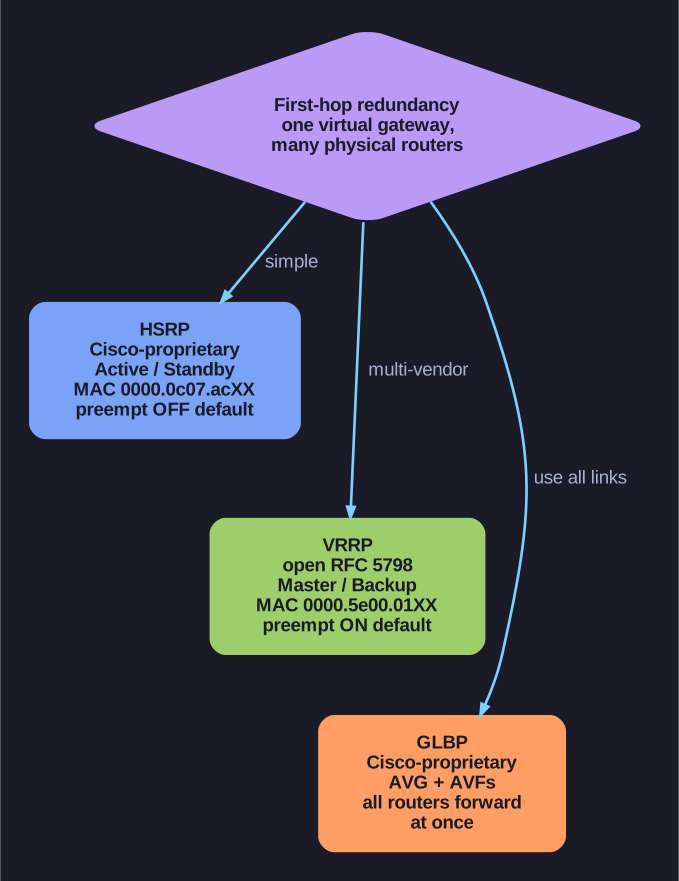
* HSRP vs VRRP vs GLBP at a glance. *
| Protocol | Proprietary? | IPv4 | IPv6 | Key Feature |
|---|---|---|---|---|
| HSRP | Cisco | Yes | No | Active/standby. Virtual MAC (Media Access Control) from group number. Most widely deployed on Cisco gear |
| HSRP for IPv6 | Cisco | No | Yes | Same as HSRP but for IPv6. Uses virtual IPv6 link-local + virtual MAC. Sends Router Advertisements |
| VRRPv2 | Open (RFC 3768) | Yes | No | Similar to HSRP. One master, one or more backup routers. Multi-vendor |
| VRRPv3 | Open (RFC 5798) | Yes | Yes | Supports both IPv4 and IPv6. More scalable than VRRPv2. Multi-vendor environments |
| GLBP | Cisco | Yes | Yes (GLBP for IPv6) | Load balancing — multiple routers actively forward. Distributes traffic across group members |
| IRDP | Open (RFC 1256) | Yes | No | Legacy. Uses ICMP (Internet Control Message Protocol) Router Discovery. Rarely used today |
The critical distinction:
- HSRP and VRRP: Only one router forwards at a time (active/standby). The standby router's bandwidth is wasted during normal operation
- GLBP: Multiple routers in the group forward simultaneously. Each host is assigned a different router via different virtual MACs (Media Access Control addresses). True load balancing + redundancy
When to use which:
- All Cisco network: HSRP (simple, well-understood, most common in Cisco exams)
- Multi-vendor network: VRRPv3 (open standard, works with any vendor)
- Need load balancing: GLBP (uses all router bandwidth, not just the active one)
Go deeper:
 First-hop redundancy protocol (Wikipedia) — enumerates HSRP, VRRP, GLBP, CARP, etc. with vendor/standard distinctions.