Quiz Entry - updated: 2026.07.30
What are the Six Thinking Hats, and what does each hat represent?
A structured creativity technique by Edward de Bono where each "hat" represents a different thinking mode.
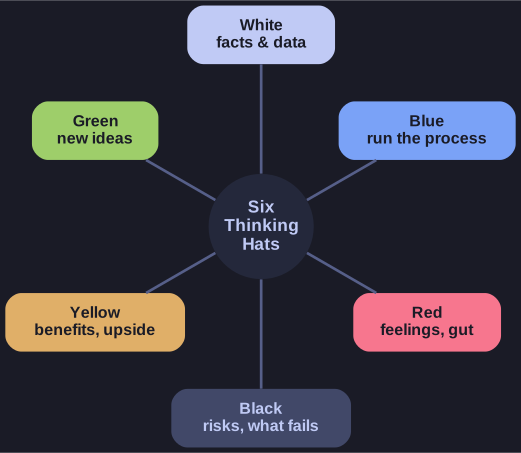
* One hat = one mode of thinking; the group "wears" the same hat at once, so every angle gets explored in turn rather than people arguing past each other. *
| Color | Mode | Focus |
|---|---|---|
| Blue | Objective & Process | Meta-thinking — controls the thinking process itself. "Which hat should we use now?" |
| White | Focused & Factual | Data, numbers, known information. "What do we know? What data is missing?" |
| Green | Creative & Free | New ideas, alternatives, possibilities. "What else could we try?" |
| Yellow | Positive & Optimistic | Benefits, value, opportunities. "What's the best-case scenario?" |
| Black | Negative & Critical | Risks, dangers, weaknesses, what could go wrong. "Why might this fail?" |
| Red | Intuitive & Emotional | Feelings, gut reactions, hunches. No justification needed. "How do I feel about this?" |
How to use them:
- Everyone wears the same hat at the same time — this prevents arguments and ensures all perspectives are explored
- The Blue Hat facilitator decides the sequence of hats
- Typical sequence: Blue → White → Green → Yellow → Black → Red → Blue
Why it works:
- Separates ego from thinking — "I'm wearing the Black Hat" is less confrontational than "I disagree"
- Ensures emotional and creative perspectives aren't suppressed by analytical thinkers
- Forces systematic exploration of all angles
In cybersecurity context:
- White Hat: What are the facts about this vulnerability?
- Black Hat: How could this be exploited? What's the worst case?
- Yellow Hat: What security improvements does this fix enable?
- Green Hat: What unconventional mitigations could we apply?
Go deeper:
 Wikipedia: Six Thinking Hats — de Bono's parallel-thinking method, the role of each colored hat, and how groups run a hat sequence.