What are the six types of handover, classified by the network elements involved?
From smallest to largest scope: intra-cell, inter-cell (intra-BSC), inter-BSC (intra-MSC), inter-MSC, inter-PLMN, and inter-system handover.
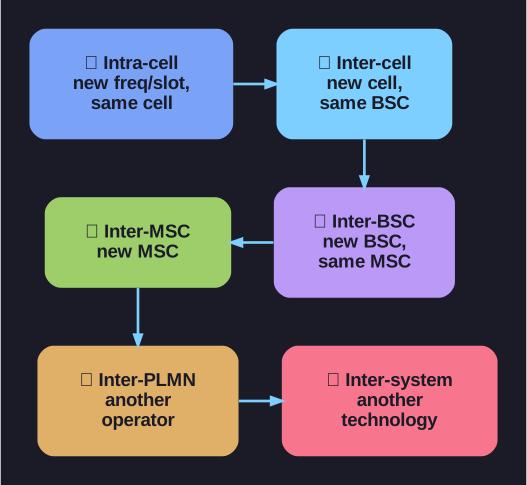
* The six handover types by widening scope. *
The taxonomy:
| # | Type | What changes |
|---|---|---|
| 1 | Intra-cell handover | Another frequency or time slot within the same cell (GSM, GPRS) |
| 2 | Inter-cell (intra-BSC) handover | A neighboring cell attached to the same BSC |
| 3 | Inter-BSC (intra-MSC) handover | A neighboring cell on a different BSC, but the same MSC |
| 4 | Inter-MSC handover | A neighboring cell whose BSC hangs on a different MSC |
| 5 | Inter-PLMN handover | A cell of a different mobile network (another operator) |
| 6 | Inter-system handover | A cell using a different mobile technology (e.g., between GSM and UMTS) |
The pattern: each level climbs one step up the network hierarchy (cell → BSC → MSC → operator → technology), and each step up involves more network elements, more signaling, and more risk. An intra-cell hop is trivial; an inter-system handover must bridge two entirely different radio technologies mid-call.
Tip: To memorize the order, walk the GSM architecture upward: same cell → same BSC → same MSC → same network → same technology — and each "same" turning into "different" defines the next handover type.
Go deeper:
 GSM handover (Electronics Notes) — the intra-BTS / inter-BTS-intra-BSC / inter-BSC / inter-MSC ladder mapping onto types 1–4.
- Handover (Wikipedia) — the general classification and the inter-system / inter-RAT concept behind type 6.